Showing posts with label Chittenden locks. Show all posts

Monday, April 3, 2017

Snagboats on Puget Sound: A Photo Essay


The snagboat Swinomish in Lake Washington, circa 1916. The lowering of the lake to accommodate the new Ship Canal left many snags exposed. The photo is credited to Asahel Curtis. 
Photo, Shoreline Historical Museum, #1249.


Snagboats were a familiar sight on the Ship Canal and on Puget Sound rivers from 1885 to 1981. The snagboats Skagit (1885-1914), Swinomish (1914-1929), and W.T. Preston (1929-1981) were charged with clearing snags and other debris from the region’s waterways. Aside from this primary duty, the snagboats were called to serve in many other ways.

For the full story of the Puget Sound snagboats, read Ron Burke's detailed and beautifully-illustrated article for The Sea Chest -- "Heritage of a Snagboat" (June 2001).


The snagboats Skagit and Swinomish side by side in 1915. Their A-frame cranes sit on the bows. 
Photo, U.S. Army Corps of Engineers.

In 1980 and 1981 Pam Negri conducted a series of oral history interviews for the Corps of Engineers with current and former crew members of the W.T. Preston. The men shared a number of stories detailing both their ordinary duties and some unexpected tasks. (Tapes and transcripts in the care of the Anacortes Maritime Heritage Center)

WHOOPIN' IT UP!

In a 1981 interview, Sandy Welsh Jr. explained that the Preston ended up with the whistles of both earlier snagboats, as well as its own:
The two big steam whistles from the Swinomish and the Skagit, they operated together. Mine was, well I call it a whooper, and it was kind of a steam siren. I operated it independently. You could kind of play a little bit of a tune with them both going. We had a lot of fun. There was a couple other steam boats that had whooper sirens on them. We would whoop back and forth.
People really get a thrill out of listening to the steam whistles. You'll go by, like through the Lake Washington Ship Canal, and people will come out of their offices or on the boat next to you and yell, "blow the whistle, blow the whistle.“ I'll always give an extra toot for a thank you for each of the bridges we go through. Most of the time the bridge tenders will give a little toot back in answer. Especially Bill, who works on the Ballard Bridge up there, he says, "how about a real long one with the bridge opening?" So, I'll give him a little bit extra long one because he really likes to hear the steam whistle. It's really funny though. You'll just see the people, and if you can't hear them you'll just see the arms pump up and down. "Blow that whistle!“ (Oral History, Virgil (Sandy) V. Welsh Jr., Second Mate and Caption on the Preston, 1975-81.  From the archives of the Anacortes Maritime Heritage Center)

BURNING DOWN THE HOUSE

Captain William M. Morgan at the helm of the W.T. Preston, 1975. 
Photo, Puget Sound Maritime Historical Society.


Captain William W. Morgan told Pam Negri about part of the job that involved burning derelict houseboats:
We used to do quite a bit of work in conjunction with the Seattle Harbor Patrol. They would assist us, either bring in snags or tell us where they were at. Anyway, we were burning a considerable amount of houseboats, and they were the ones that were towing the boats down to Montlake across from the old canoe house at the U.W. There were times when we would have a half-dozen houses. We would burn them right down to the logs, then pick the logs up and set them on the beach.

This one particular time, we used to go in and open the valves or break the water lines so there was no water remaining to cause any possible explosions. We'd gone through this one house and broke a few lines, opened all the valves we could see. Then we set our fire. Well, it was really burning pretty good. The old tar paper roofs-everything was really going strong. Here comes a harbor police boat heading toward the shore-must have been an emergency. We were all standing on our deck, watching this houseboat burn when all of the sudden there's this terrific explosion. Here goes this hot water tank, shooting out across the water, landing right in front of this police boat coming full out towards it. It was pretty funny at the time, but could have been extremely serious.

[The Harbor Patrol] kind of laughed it off. Particularly one of them that I knew quite well, he said, "Wouldn't that look good on the front page of the PI [Post-Intelligencer], Preston torpedoes Seattle police boat with hot water tank." (Oral History, William W. Morgan (Tape 16), Deckhand, First Mate, Second Mate, and Captain 1952-1982. From the archives of the Anacortes Maritime Heritage Center)


COWS ON THE BRINK

Norman Hamburg began his career as a cabin boy on the Swinomish in 1927 and later transferred to the Preston. In his 1982 interview he told Pam Negri about one little-known aspect of the work:

A lot of times there was a lot of erosion along the [river] banks. The cows would get too close to the edge of the bank eating grass, and sometimes the bank would cave in and down would go the cow in the river. We picked up quite a few cows in the river, set them back down on the bank for the farmer. [How?] Put a rope sling around 'em, just behind their front legs and just ahead of their rear legs, picked 'em right up with the donkey engine and swung them over and set them on the bank. They very seldom hurt themselves; they landed on the soft mud in the river there.  (Oral History, Norman Hamburg (Tape 10), January 15, 1982. From the archives of the Anacortes Maritime Heritage Center)


Crew of the W.T. Preston, 1939. U.S. Army Corps of Engineers. 


WARTIME

Hamburg explains the effect of World War II on the snagboat business:

During World War II, when they stopped all river and harbor work, they tied the Preston up at the locks wall. They transferred all the laid-off crew that didn't have 15 years of service in. They found other jobs for them, but what I mean [is] they were laid off the Preston. They kept the captain, the chief engineers, myself and the cook. We stayed aboard the vessel for quarters and helped keep the vessel in shape, and we were transferred over to the locks. The chief engineer and I were transferred over to the machine shop -- working for Charlie Seagren. We were outfitting boats for Alaska and a lot of the boats were going up to [Adak?] Island, building the airbase up there. Also, the Alcan Highway [Alaska-Canadian]: we did a lot of work at the locks for the Alcan Highway making different things in the machine shop and the blacksmith shops. They didn't bring the Preston out until after World War II....but they kept us crew aboard in case some emergency would arise.
I remember when we came to work on December 8th [1941]; it was on a Monday morning. Driving down from Mount Vernon, we were stopped at the main gate going in -- soldiers galore. Went through  our suitcases. They went through our luggage and they walked with us down to the Preston to get verification that we belonged to that crew. Our cook -- little Fritz -- fed about, I'd say, 30 soldiers for the meals on the Preston until they had facilities built and they built barracks down at the locks for these soldiers to stay in because they were on guard there -- on duty 24 hours a day. The barracks at that time were built on a wall just west of the administration building. 
One of the first jobs the snagboat had was to lay a cable across from the small locks over to the south end of the spillway to hang a netted, mesh fence on there to stop anything that could drift down to blow up the spillway. Everything was very vulnerable. They had blackouts for all the sawmills, the homes, the street lights -- everything had to be turned out at dusk and you had dark blinds over your windows in the homes. There was absolutely no light on the west coast at all, until they found out just how vulnerable it was. They were afraid of a Japanese attack on the west coast. 
There were a lot of boats tied up in Lake Washington and Kirkland in the area.....Lake Union....and if something would have happened to the locks there, it would have drained the water out of Lake Union and been a real disaster. (Ibid.)
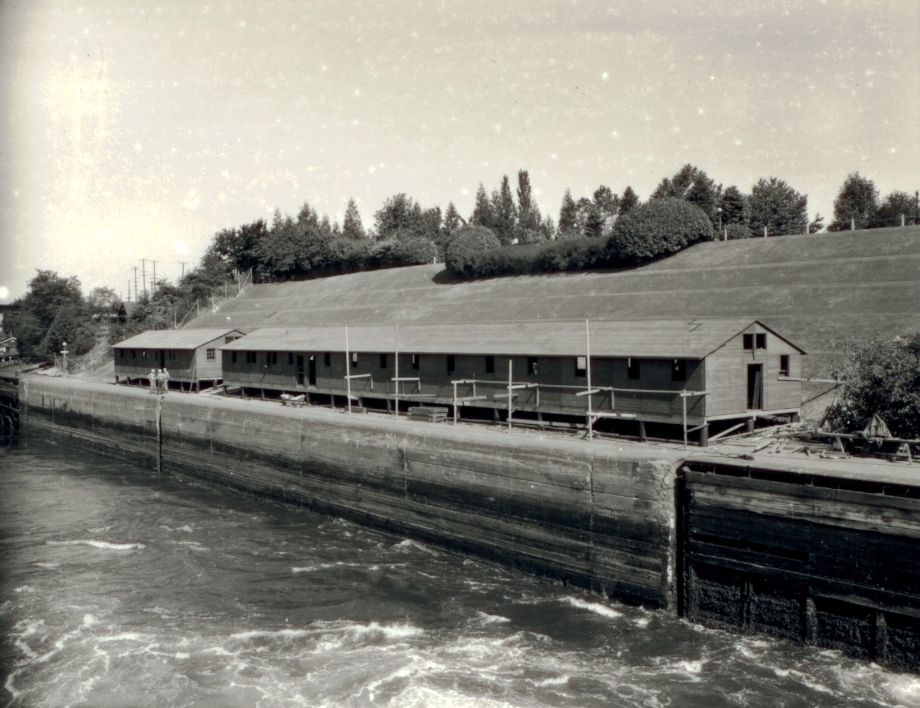
Coast Guard barracks and mess hall at the locks, August 14, 1943. 
Photo, U.S. Army Corps of Engineers.


The last of the Puget Sound snagboats -- W.T. Preston -- was retired in 1981. Such snagging duties that are left on our well-traveled waterways are now carried out by the Puget, a small derrick barge. Two years afterwards, the Preston was acquired by the Anacortes Maritime Heritage Center where she may be seen today.

-- Eleanor Boba


The W.T. Preston, with sternwheel, was an impressive sight passing through the locks, February 3, 1972.
Photo, U.S. Army Corps of Engineers. 


Monday, April 25, 2016

Making the Cut: The Locks by the Numbers

Puget Sound Maritime researcher Joe Baar gives us some insights into the monumental undertaking that was and is the Ballard Locks. This is one of an occasional series of essays commemorating the centennial of the Ballard Locks and the Ship Canal.


Early, undated photo of the "government locks," probably mid-1940s. Puget Sound Maritime Historical Society, Joe Williamson Collection, Negative # 2301-4.

Early Efforts

By 1854 a navigable connection between Lake Washington and Puget Sound to allow movement of logs, milled lumber, and fishing vessels between these bodies of water was being discussed sporadically. After the Civil War, in 1867 the U.S. Navy endorsed a canal project, which included the idea of constructing a naval shipyard on Lake Washington. In 1891 the U.S. Army Corps of Engineers began planning the project; some preliminary work occurred in 1906.

Legal challenges mounted by Ballard mill owners who feared property damage and loss of waterfront in Salmon Bay, and by Lake Washington property owners whose docks and waterfront would be left 9 feet in the air, delayed construction for another five years. Work finally began after midsummer 1911 under Major Hiram M. Chittenden’s command. All the delays in planning and construction finally caused the Navy to establish the Puget Sound Naval Shipyard across Puget Sound from Seattle, in Bremerton.

To facilitate expected maritime traffic, three low bridges and trestles crossing the ship canal route were removed, at Fremont Avenue, Stone Way and Latona Avenue. New bridges in Ballard and Fremont were completed in 1917, followed by University Bridge in 1919, and Montlake Bridge in 1925. University Bridge was improved in 1932, and in 1934 the Corps declared the Lake Washington Ship Canal project complete.


Dates, Size, Usage

Construction began on the Government Locks August 6, 1911. Both locks opened to traffic in the summer of 1916, the small lock on July 30 and the large lock on August 3. During those four years and eleven months the U.S. Army Corps of Engineers excavated 1,661,400 cubic yards of earth for the Salmon Bay locks and dam alone, then filled the resulting basin with 227,000 cubic yards of carefully-formed concrete.

The Corps reported Hiram Chittenden Locks hosted 1,300,000 visitors and conveyed 50,000 watercraft and 1,000,000 tons of commercial goods during 2013. As the price of oil declines, we can expect even greater volumes in all these categories.


Comparison with Modern Structures

Modern comparisons show the relative size of this undertaking. Forty-five years after the locks first carried traffic, the Seattle Space Needle’s foundation was completed in 1961 using continuous 24-hour concrete placement into a mass requiring 2,747 cubic yards of concrete. In 2015 the Amazon Complex’s Block 19 Mat Pour, the building’s foundation within the block bordered by 6th and 7th Avenues and Lenora and Blanchard Streets, required more than 12,000 cubic yards, which covered the excavation’s bottom more than 12 feet deep in concrete and reinforcing steel. The volume of concrete used to construct the Government Locks amounts to about 19 times what the Amazon Block 19 Mat Pour required, and is about 83 times what the Space Needle’s 5,600-ton foundation used.


The Cuts - Fremont

A continuous waterway extending from Puget Sound to Lake Washington requires two separate and sequential channels excavated through intervening landforms. Westernmost of these is the Fremont Cut, named for the Fremont neighborhood lying just across a swale north of Queen Anne Hill. In 1883 the Lake Washington Improvement Company contracted with the Wa Chong Company to provide immigrant Chinese labor to dig the Fremont Cut along the low-lying route of Lake Union’s outlet, Ross Creek, to Salmon Bay, which was tidal salt water until the Government Locks were in place. After excavating this section in 1885 the Wa Chong laborers moved on to complete the log sluice at the Montlake Portage, located near and beneath today’s State Route 520. All this work was accomplished solely by use of hand tools.

The Fremont Cut’s eastern end near Fremont Avenue was separated from Lake Union by a low wooden dam, a small wooden lock, and a spillway. The cut thus continued Ross Creek’s function as an overflow drain for Lake Union and Lake Washington until the Government Locks at Salmon Bay were finished in 1916, which caused the water level behind them to rise and meet that of Lake Union. Shortly afterward Lake Washington drained westward until all the fresh-water bodies’ elevations equalized.

The Fremont Cut is approximately 5,800 feet long. The maintained ship channel taking up the center section of this waterway is 100 feet wide and 30 feet deep; the cut’s entire width, bank to bank, is 270 feet. The total amount of material excavated for this cut is thus around 2,200,000 cubic yards.


The Montlake Cut in snow, looking east, showing the remnants of the coffer dam, circa 1916. Puget Sound Maritime Historical Society, Joe Williamson Collection, Negative #10345.


The Cuts - Montlake

The easternmost cut at Montlake was originally named the Erickson Cut, after the first contractor hired to excavate this section. The Corps’ Major C.W. Kutz awarded C.J. Erickson’s contract on August 7, 1909, and dry excavation proceeded from October that year until October 26, 1910, when the dike on the Union Bay end of the cut was dynamited, allowing water to fill it. Further hydraulic excavation by Stilwell Brothers continued until June, 1914, and temporary wood cofferdams replaced part of the earthen dikes at both ends of the Montlake Cut to allow control of its water level so work on the Montlake Bridge’s abutments and foundations could proceed. After the last bond issue funding this construction passed in 1915, the bridge’s foundations were finally begun.

On August 26, 1916 the Portage Bay cofferdam was removed, followed several days later by the one on the Union Bay end. Lake Washington’s level then descended 8 feet 10 inches over the following three months, and the Lake Washington Ship Canal gradually assumed its normal level from Lake Washington, through Lake Union, to the Government Locks.

The Montlake Cut is approximately 2,500 feet long. The maintained ship channel taking up the center section is 100 feet wide and 30 feet deep; the excavation’s entire width between the high points of each bank, is 350 feet. The total amount of material excavated for this cut is nearly 2,400,000 cubic yards.


Observations from Today

The entire span of time between Thomas Mercer’s discussions with his fellow-citizens about what the inland lakes should be named, until the Corps of Engineers declared the Lake Washington Ship Canal complete, amounted to eighty years. Today we look forward with great impatience to the promised completion of several major public works projects, also related to transportation, in the central Puget Sound region. We are not able to calculate the cost of this new infrastructure with any real certainty, and discovering how much the Lake Washington Ship Canal actually cost the citizens, beginning 162 years ago until all the financing bonds were retired, is a task beyond the scope of this short article. What we do know from our own experience is, it wasn’t cheap then and it won’t be cheap now. These great expenses provide immense known and imagined benefits to all citizens for a very long time to come. Public works of this scale animate our society now and help bring the promise of a bright future for all of us.


Sources include the H.W. McCurdy Marine History of the Pacific Northwest; David Williams, Too High and Too Steep: Reshaping Seattle's Topography; Adam Wood, Images of America: The Ballard Locks; Sellen Construction Company, "Block 19 Mat Pour, October 4, 2014; HistoryLink.org.


-- Joe Baar

Joe Baar has been fascinated with ships since his childhood on Brace Point. His lifelong avocation has included stints with the Sea Explorers, small boat school courtesy of the U.S. Army, working on yachts on Lake Union, and amassing a large collection of maritime books.