BY LUCILE MCDONALD Edited by Eleanor Boba
Well-known journalist,
author, and historian Lucile McDonald compiled this history of PSMHS in the
early 1970s. Five years later she added an addendum covering the years 1974 to
1979. McDonald’s history ends just prior to the Society’s acquisition of the
Joe Williamson Photography Collection.
The editor has
transcribed McDonald's type-written essays largely verbatim except where slight
changes were needed for clarity. A few lines of the first essay have been lost
to time. These essays have not been published previously.
PART I
For two years prior to March, 1948, a group of ship lovers and waterfront businessmen in Seattle kicked around the idea of forming an organization to preserve marine artifacts and lore while there were still some who remembered the romantic days of shipping on Puget Sound. Finally, they decided to call a meeting on April 1 in the upstairs room at Ivar’s Acres of Clams restaurant. That proved to some extent an April Fool’s joke, for only five men showed up – Joe Williamson, Jim Gibbs, Bob Leithead, Tom Sandry, and Austen Hemion.

The five founding members of PSMHS: From Left: Jim
Gibbs, Tom Sandry, Joe Williamson, Bob Leithead and Austen Hemion, 1948. PSMHS Photo, Negative No. 8216
They were not the least discouraged by this small response,
but went ahead and constituted themselves an executive board, calling a second
session two weeks later at the same place. Word got around that they were in
earnest and 21 men turned out. Among them were Jack Dillon, Captain Bob Matson,
Wilbur Thompson, Frank Ewers, Harry Anderson, Bill Bailey, Earl Peterson, Bob
Lund, Stuart Prestrud and Bill Somers. In the beginning, at the urging of Fred
Geibel, editor of the Marine Digest,
they called themselves the Puget Sound Steamship Historical Society, but this
did not set well with the board members. Giebel visualized them as constituting
a chapter of the nation-wide Steamship Historical Society, but the group
preferred an independent strong local identity. Therefore, to Geibel’s regret,
they soon altered the name to Puget Sound Maritime Historical Society, which it
has remained ever since.
Most of the 21 men who toasted the new organization in clam
nectar are still active members. A photograph taken at the second meeting
showed a young aggregation except for a couple of veterans, Captain N.A.
McDougall and Captain Hugh Gilmore, now deceased.
Officers elected were Williamson, president; Sandry, vice
president; Hemion, secretary-treasurer; and Gibbs, program chairman. It was
thought the Transportation Club could be used for meetings, but this did not
work out and the early ones were held at the Gowman Hotel and the Seattle Yacht
Club, where Webster Anderson was a member. The board of directors meanwhile met
at private homes, often at Sandry’s where they gathered around the piano and
sang after business was completed.
Members liked the Yacht Club, where they could sit in front
of the big fireplace and spin yarns about ships, but a young people’s group
scheduled square dance lessons for the same night and the competition became
too difficult to cope with, so the society moved back to the Gowman early in
1949. It was still eating there when the hotel became the Stewart.
One of the first activities the society engaged in was sponsoring the race between the Sightseer and the Virginia V as part of the port’s Maritime Day program. This took place only a couple of months after the founding of the organization. Jim Gibbs was prime mover of the event.
Dinner speakers that initial year included Captain E.B.
Coffin, master of the express steamer Tacoma, and Captain J. Fletcher Ruttle,
who has been master of a Liberty ship for Northland Transportation Company
during the war. The latter presented his own motion pictures taken during two
years in the Antarctic. Captain Coffin in December became the first honorary
life member. At the same meeting, it was voted to retain all the incumbent
officers for another year. A roster of charter members was made up, showing a total
of 34, of whom three were women.
The impression had prevailed that the society was for males
only and while they were still meeting at the Yacht Club a woman showed up for
a session. She must have felt uncomfortable, for she never returned.
In April, 1949, the group celebrated its first birthday with
an old-fashioned box social aboard the Virginia
V. Ken Ayers was master of
ceremonies and Chuck Day acted as auctioneer for the decorated boxes after a
prize was given for the prettiest one. The boat cruised an hour without cost to
the members, but the lunches were for cash. During the festivities, Captain
Howell Parker of the Virginia V was
presented with the second honorary life membership.
This was in the days before the Seattle Historical Society
erected its building [MOHAI at Montlake] and the maritime group was badly in
need of a place in which to store artifacts. A first suggestion that the
University of Washington be asked if it could spare space brought no response.
The maritime society made its debut in the field of exhibits at the Seattle
Boat Show in February, 1949 when it provided a display in cooperation with the Marine Digest. After that the Chamber of
Commerce offered storage space near Wolfe’s Marina, but several members
inspected it and rejected the proposal. Another space was offered by C. Arthur
Foss aboard the ship Cheakamus, which
the society might also use for headquarters and a museum. Again, a committee
went forth, this time to Kennydale, to inspect the vessel, but the proposal
evidently was considered impractical, as it was dropped after discussion at the
February meeting. It would have entailed providing a moorage and necessary
maintenance of the vessel and displays.
Storage was a pressing problem, as part of the
organization’s aim at the very beginning had been to preserve as many souvenirs
and pictures of old-time vessels as possible. Not a few of the charter members
engaged in what was facetiously termed “moonlight requisitioning” when they
visited a hull about to be demolished or disposed of for a breakwater and combed
it for any significant equipment that might have been left. They were not
averse to tramping over tidal flats and extracting pieces of derelict vessels
embedded in beaches. No source was overlooked; the society openly solicited
gifts of engines, steam whistles – just about anything. But where were the
trophies to be kept? Some were in members’ attics, basements, and garages, but
the collecting was entirely too ambitious for the accommodations. For instance,
one of the first items the society discussed going after was the steam engine
of the tug Pioneer owned by Pope
& Talbot.
 |
| The steam tug Pioneer. Undated photo courtesy of Puget Sound Maritime Historical Society. |
Another project proposed that initial year was compilation of
a master list of members’ private libraries of books about the sea. As a basis
for programs Jack Dillon offered to pick two historical ships for discussion at
each meeting.
In August, 1949, it was decided to issue a news letter incorporating
each meeting announcement. To begin with this was a single mimeographed sheet
containing items of interest. To sharpen wits Austen Hemion,
secretary-treasurer, included sample questions for members to think about and
discuss: What was the first automobile ferry to run to Bainbridge Island? What
was the first steamer under American registry to operate from Puget Sound to
the Orient? What was the name of the first steamer of iron or steel on regular
schedule from Puget Sound to Southeastern Alaska?
That fall Joe Williamson and Jim Gibbs promoted the idea of holding
an annual dinner to honor waterfront old-timers. Ken Ayers, who was master of
ceremonies at that initial banquet, recalls that between 150 and 200 attended
the event in the Transportation Club. The committee underestimated attendance
and a partition had to be removed in order to accommodate so many. Numerous
guests were men past the age of 70 and Gibbs had a difficult time singling out
the oldest, settling at last on Captain Fred P. Harlow. George Westerman proved
to be the oldest in active service. Awards were given both. Other honored
guests were Captain Everett B. Coffin, J.H. Buxbaum, Captain Zu Murry, Rob
Ross, Captain Zipp Wyatt, F.H. Marvin and C. Arthur Foss. Pictures of old ships
and slides were exhibited as part of the program, which included songs by Ivar
Haglund and community singing led by Chuck Day, with Tom Sandry at the piano.
Captain Howell Parker was presented with a plaque [….and
another] was set aside for Captain Harry Wilson of the Sightseer, who could not be present. The climax of the evening was the
unveiling of the original bell of the Victoria,
formerly the Parthia, loaned for the
occasion by G.W. Skinner. Brief speeches were made by W.E. Springstun, who was
on the Dora during her famous drift
in the North Pacific, and by Captain Henry Foss. The gathering was so
successful that there was no question but that it would be repeated.
Next year’s old-timers’ night was staged at the Masonic
Temple and brought out an attendance of 206. Ayers was again master of
ceremonies and one of the features was an exhibit of the models of the Puget
Sound Navigation Co. fleet and the Colman Dock, brought by Bill Somers from his
private museum on Stretch Island.
In 1950, the society sponsored a more ambitious race on the
waterfront, with 18 tugs entered. It received a generous amount of publicity
and the June meeting was devoted to a discussion of the benefits of the race
and the showing of pictures taken during the contest. The course was 4.9
nautical miles, there were three classes of entries and the winners of first
place in each were the USS Tatnuck,
the ST 860, and the Ajax.
Participation in the towboat races became a greater
financial obligation than the society could afford, although it joined with the
Propeller Club in sponsoring them. However, it had to get out of the races
because of the cost and the fact that tugs could not be spared for
participation in the event. Vivian Smith in 1952 received an award from the Propeller
Club for work she did in its behalf.
Programs of the society invariably were interesting, in fact
the quality of discussion and speakers furnished for the meetings has always
been a great drawing card. Here are some of the early ones featured: George
Treadwell, chief engineer of the Port of Seattle, with slides to illustrate his
talk; H.C. Hansen, naval architect; Commander Ben Wilcox, on his experience in
the Coast Guard; Alan McDonald, on his work at Acapulco, Mexico, in connection
with the stranding of the cruise ship Corsair; A.J. McGree, on the government
locks; Captain John Backlun of the schooner C.S.
Holmes, with his motion pictures showing arctic trading; a speaker from the
Coast Guard on “the Weather Man at Sea;” Dr. Dorothy Johnson, of Portland, on
the history of the Oregon Steam Navigation Co.; Captain Alan Villiers; Captain
Loring F. Heyde, of Port Angeles, on his work as a salvage officer in two world
wars; the origin and history of the compass; Mike Shain, on early pleasure boat
building and racing; C. Arthur Foss on early towboating; Robert Hitchman on
Washington coastal names; Black Ball night with Alexander Peabody as speaker;
Captain Ralph E. Fielding on his 27 years as a naval physician; Howard Lovejoy
and his aunt on the Coupeville saga, and Captain Frank Huxtable on the heroic
effort to salvage the North Sea,
stranded on Porter Reef.
Sometimes the meetings were simply billed as “gab-fest and
picture-guessing night.” At another time, Professor Charles Gates of the
University of Washington spoke on “The Puget Sound Story – How Can the Society
Tell it?”
At a board meeting in May, 1951, the question of becoming
incorporated was raised. Austen Hemion headed a committee to investigate the
wisdom of this and what it would cost. In November of the same year, the
incorporation under the laws of Washington as a nonprofit voluntary association
was effected.
The status of women in the organization was laid at rest at
the January, 1951, meeting when Ruby El Hult[i] was elected secretary-treasurer. Vivian Smith already had
joined, having attended a session “to find out just what kept her husband out
on meeting night.” She enjoyed it so much she applied for membership. Two years
later she was editing the news letter when her husband, Floyd, was
secretary-treasurer.
The news letter started as a one-page sheet with board
reports and announcements of meetings at the top and news items filling the
rest of the page. It expanded to two pages, partially discussing maritime
subjects for members to ponder. For several years, Vivian Smith typed and
mimeographed this publication at home and attended to the mailing. Then in
March, 1955, John W. Todd took over the job and in November began publishing a
more ambitious sheet from his office in the Shorey Book Store. This would
permit addition of supplements contributed as the result of members’ research.
Ruby El Hult and Captain McDougall already had provided several extra pages in
the earlier issues. McDougall combed old files in libraries, dug into stories
about early vessels, and worked so diligently he was for a time appointed
historian. He was still at it when he died suddenly May 13, 1957.
From the beginning, there had been an attempt to fill four
appointive positions of registrar, librarian, custodian, and historian. In 1950
Bob Leithead volunteered as historian, Lloyd Stadum as librarian, and Joe
Williamson as custodian [curator]. The following year one of the board meetings
devoted a long time to discussion as to how to interest members in
participating in research. Again, in October, the problem of storage came up,
as Bill Bailey no longer could take care of acquisitions and the society needed
to find someone with space for them. Tom Sandry offered to house them for a
limited time, but Williamson thought the stuff could be farmed out to more members.
All were dreaming of having a real museum and the Marine Digest offered space in an empty
room at 81 Columbia Street, beside its office. Vivian Smith remembers several
of the members climbing on ladders to clean out cobwebs. They gave the room a thorough
going over before installing the exhibits. “We opened on a Saturday afternoon,”
Vivian recalls. “Eve Hitchcock and I baked cookies and served coffee. Austen
Hemion helped us get ready. We worked like a bunch of idiots before the place
opened.”
The museum on Columbia Street was fairly short-lived. The Marine Digest moved and in the fall of
1954 the artifacts had to be gathered again and were stored at the Bell Street
terminal for several years. After the Museum of History and Industry erected
the first unit of its building the society brought out some of its treasures
and loaned them for it first exhibit in that structure in March, 1954. At the
time, there were several other sponsors of the display, including the Port of
Seattle, the Propeller Club, Seattle Historical Society, and the H.W. McCurdy
collection. (McCurdy had been collecting ever since 1921.)
Somewhat later the society again loaned artifacts to the
museum for a mosquito fleet exhibit in 1956, viewed by 17,000 spectators.
Vivian Smith headed a women’s committee who served refreshments at the opening,
attended by 1,400. Much work went with preparing the exhibit. Eva Hitchcock
typed all the display cards. The mosquito fleet was always a popular subject;
visitors enjoyed particularly seeing the models and old pictures of early day
Puget Sound vessels and this type of exhibit has remained standard fare from
time to time up to the present.
What had started as an easy-going association to talk about
boats and the sea had taken on a good many obligations. Being a member of the
society was no longer a hobby; sometimes it was a heavy chore. There was, for
instance, the old-timers’ night. A question arose as to whether anyone would
take charge of arrangement for the third banquet, in 1951. At first there was
no response, no one could spare the time, then Floyd and Vivian Smith rose to
the occasion and the event was saved from foundering. It was staged that
November again at the Masonic Temple. A complaint was voiced that only 30
members attended, some having the mistaken idea that dinner was only for old-timers.
Chris Querin, who had been operator of the Arlington Dock, was the speaker, Don
Venables sang, Tom Sandry was at the piano, and Bill Bailey, Jr. played the
accordion. Ken Ayers phoned long distance to wish the gathering luck; he was by
this time at the Armed Forces staff college at Norfolk, Va.
The fourth annual banquet moved to the Benjamin Franklin Hotel, with the gangplank down at 3 p.m. for coffee, and dinner was served at an early hour. Captain Ben Joyce, Sr. was speaker, Captain Frank Huxtable was master of ceremonies and pictures were shown by Joe Williamson and Bob Leithead.
The advertised speaker for the 1954 old-timers’ meeting became
ill two days before his much-publicized appearance and there was no choice but
to turn the meeting over to the old-timers themselves. About 15 were warned by
telephone that they might be called upon and they responded with great
enthusiasm. Not all had a chance to speak their piece before the hour became
late and a halt had to be called. It was declared one of the best programs to
date.
Next year the speaker was Captain C.W. Cates, Mayor of North
Vancouver, on “Adventures in Sail and Steam.” Both those dinners were at the
Stewart Hotel.
From time to time the board of governors had asked
themselves if they were carrying out their goals and giving the society real
meaning in the community. The early, motto, oft repeated in the News Letter,
was “For the collection and preservation of objects and data of maritime interest.”
But what was the use of saving them if there was no place where they could be
seen and utilized? Though acquisitions continued to pour in, little could be
done with them except to mount loose photographs in albums. Regret was felt
that some sailing ship pictures were being lost due to the energetic search
conducted for the San Francisco marine museum. [The San Francisco Maritime
Museum was established in 1951.]
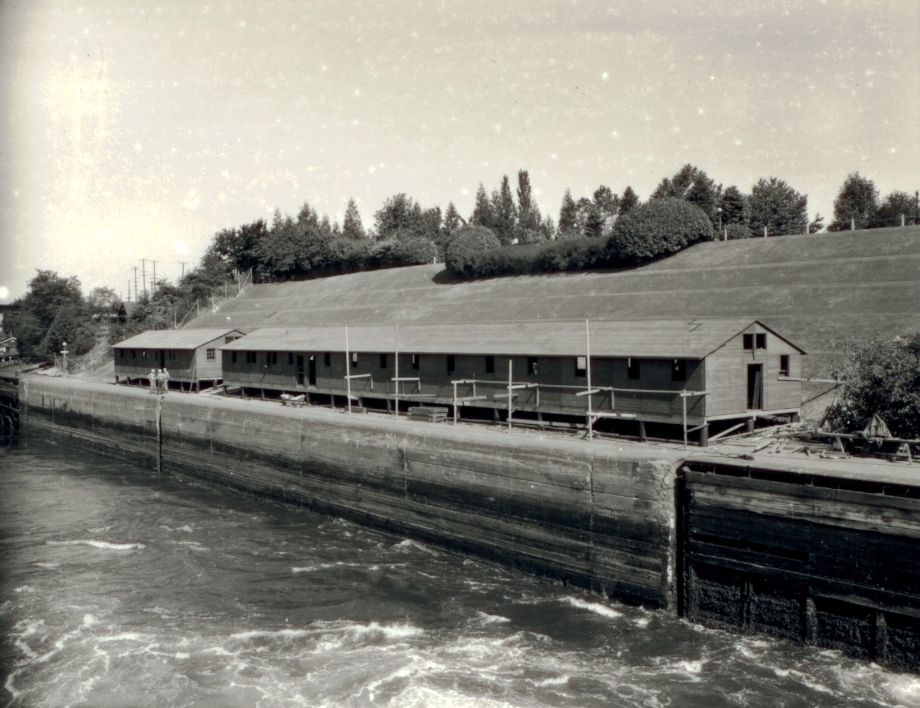
The society’s was the not the first attempt made in Seattle
to sponsor a maritime museum. As far back as 1934 the Puget Sound Academy of
Science had moored the old square-rigger St.
Paul near the Chittenden Locks and fitted her out with artifacts and photographs.
Thousands of school children, tourists, and marine-minded citizens visited her
before the craft was pronounced unseaworthy. Her spars had to be removed and,
in 1940, she was towed to Vancouver Island and sunk as part of a breakwater for
a logging company [at Oyster Bay].


The St. Paul, a short-lived marine museum and aquarium, at the Locks, circa 1934. Photo courtesy of Puget Sound Maritime Historical Society.
Her departure from the scene was deeply mourned and since
all efforts to replace her with another old ship seemed doomed to failure the
Maritime Historical Society altered its goal of a waterfront museum and joined
forces with the Museum of History and Industry in an effort to finance a new
wing for nautical collections. The museum already owned more sea-oriented
artifacts such as figureheads, old sextants, hundreds of pictures, name-boards,
and other items than could be accommodated in available display space.
In January, 1954, the executive board established a building
fund, to begin with life memberships. Webb Anderson was first to buy one and
Floyd Smith was second. It appeared practical to construct an annex to house
all the marine material and in 1956 Floyd Smith was appointed head of a
fund-raising committee sponsored by the society. Plans already had been drawn
for the addition to the Museum of History and Industry and a goal of $100,000
was set to finance it. The structure was to be 53 feet wide and either 81 or
100 feet long, depending upon the state of the exchequer. It would allow for a
display room on the main floor and office and storage space below. Smith said
it was to have been approached with four steps down. The members objected; they
were thinking of years ahead when they might not be sure-footed.
Other members of the committee were John W. Todd, Horace W.
McCaurdy, Coiln McLennon, Robert Hitchman and Ralph Hitchcock. Their meeting
place was the pilots’ office. Individuals made calls upon steamship companies,
but only succeeded in securing gifts from four of them. Many persons were solicited for whatever
amounts they were willing to donate. The backbone of the fund consisted of 27
life memberships of $100 each, which became what Smith termed “seed money.” It
was used for brochures and other expenses. McCurdy’s private secretary
volunteered some of the work such as writing letters.
“We worked six or eight months on the drive,” Smith said. “There were lots of small donations, but we had a tough time until Horace McCurdy, acting in behalf of the Seattle Historical Society, brought in Dwight Merrill and Joshua Green. McCurdy also gave generously himself. I remember that McLennon and I used to go and see Green and invariably he wound up saying, ‘You know, Floyd, the waterfront is in my heart,’ but we didn’t know where we were with him until McCurdy pinned him down.”
Another consideration which occupied the committee for a
long time was that, although the fund reached $1147,000, it was not all in
negotiable form. The building’s actual cost was $136,000, of which very little
in the end was raised by the society.
At length on August 8, 1958, ground was broken for the
maritime wing, Vivian Smith, Bob Hitchman, Joshua Green and Horace McCurdy
manning the shovels along with the mayor and others. Floyd Smith was unable to
be present, so Vivian took his place. The building opened June 9, 1959, with
more than 1,300 persons attending the evening program, which was heralded with
the characteristic blasts of a steam whistle, this time from the historic Sound
vessel the Politofsky that had once
been a Russian gunboat. This same whistle became a part of the permanent
collection. In 1909, it had blown for the opening of the Alaska Yukon Pacific
Exposition.
By 1956, a tape recorder had been acquired by the society
for the purpose of preserving worth-while addresses at the meetings. Had this
practice been followed in earlier years many a speaker’s narrative of pioneer
shipping in the North Pacific could have been added to the collection. These
were experiences impossible to recapture.
There were speakers on such subjects as “Early Tugs on Puget
Sound,” the works of the Coast and Geodetic Survey, the Dew Line, Admiral
Donald B. MacMillan and his Arctic adventures, Edward Allen on LaPerouse’s
explorations, author Kenneth Dodson, Captain Carl M. Hansen on an expedition to
record Arctic drift, two fisheries experts telling of a trip to Kamchatka and
Sakhalin Island, Dr. Victor Scheffer on the fur seal islands, a Coast Guard
officer with a film on the cutters that sailed the Northwest Passage, the
commander of the icebreaker Burton Island
on his just-completed trip to the Antarctic, Bill Holm on early Indian canoes.
There was always something stimulating in the programs and sufficient variety
to attract an audience of varied ages.
Usually once a year the society sponsored a boat trip of
some sort. In September, 1957, it made the final crossing of the ferry Chippewa to Bremerton under command of
Captain Louis van Bogaert. Cake was served on board, whistles were blown
frequently, and tickets were free to members for the round trip. In 1964, there
was a cruise aboard the Thea Foss to
Port Townsend and again that year members made an excursion to Victoria on the Princess Marguerite and were bussed to
the Maritime Museum at Esquimault. Another cruise on the Thea Foss was around Bainbridge Island.
Usually the first session on the fall calendar called for
reports of interesting marine vacation trips made by members. For the tenth anniversary
meeting Joe Williamson arranged a display of photographs of early society activities.
This was the first time the society experimented with a no-dinner meeting at
the Museum of History and Industry.
Over the years the organization had received an increasing
variety of gifts, among them a harpoon gun for whaling, the Seth Thomas clock
from Burroughs Island Lighthouse, 10 half-hull models of ships from a marine
architect’s estate, a knot board, a kerosene powered sailing ship’s starboard
running light, a telegrapher’s key with a British tuppence soldered to it as one
of the breaker points, a volume kept by the official wine measurer of the Port
of New York, the records and papers of the Puget Sound Navigation Co., the lens
from Patos Island Lighthouse --- these were just a few items among the hundreds
that came in.
In the beginning, Lloyd Stadum was willing to be librarian
and keep track of the receipt of books, magazines, pictures, postcards, albums
and circulars, but after five or six years the task required more than 20 hours
every week and he asked to be relieved. This was done and Alexis Alvey took
over for a while, but in another six months Stadum was at it again and he has
been so occupied consistently ever since. In 1962, he was made an honorary life
member in recognition of his long service as a librarian.
The most important literary acquisition was the Jack Rabell
collection of books on marine subjects, a private library which the Alaska
Steamship Co. purchased and placed in custody of the society in 1961. Rabell
had spent 14 years assembling it. He was American representative of the World
Ship Society. His collection gave the Maritime Historical Society one of the
best marine libraries in the country. However, the material is not yet fully
organized.
From the time when John W. Todd became a member he took a
prominent part in the society, not only editing the News Letter, but offering
his book shop as a place for board meetings. When contributions for the
bulletin did not arrive in time he filled the pages with poems about the sea,
jokes culled from old Readers Digests,
and sometimes with selections that had a devout slant. Alexis Alvey also sent
in a column headed “Beachcombing Among the Bookshelves.”
Publication of the News Letter was then the group’s major
item of expense. Artwork for it was donated by Mrs. Otto Marsh, who illustrated
Shorey’s catalogues. Doc Freeman and his wife handled the mailing. By 1963, the
publication ran as many as 16 pages in its supplements and another eight pages
for the letter itself, plus a colored sheet for cover.
Eventually ten members addressed a letter to the board of governors in 1961 requesting that no more articles of a religious nature be printed, since they were not in accord with the purpose of the society. A committee was appointed to review the matter, and, after being considered at two board meetings, it was voted that nothing controversial should appear in the space allotted to Todd for editorial comments.
By 1963 there were suggestions from members to publish a
quarterly, reduce the news letter to a one-sheet program announcement, cut out
the supplements and limit the content only to maritime articles of historical
nature. [Old members were encouraged] to think and write about the past.
The board [ultimately] chose a middle course as a result of
the discussion and the News Letter ended its career with the March, 1967,
issue. The Sea Chest was launched the
following September and the practice of sending brief monthly meeting
announcements began. The society then had 226 paid-up members.
William O. Thorniley edited the first issue of the
quarterly, which had for its editorial board Wilbur B. Thompson, then
president, Bob Leithead, Jim Vallentyne, Tom Sandry, and Hal H. Will. By the December
issue Hal Will had become editor. Gordon Jones also joined the editorial board
and Roy J. Storey was handling circulation.
The second number was dedicated to the memory of James Davenport
Vallentyne, who in the interval had been tragically lost at sea. He was
credited with having put in much time and effort to make the initial Sea Chest a success. He had been
president of the society in 1959 and 1960 and his home was then the meeting
place for the board of governors.
For a time, regular sessions in the Museum of History and
Industry were tried out, but the membership preferred gathering for dinner, so
except for special programs this became the rule. The place had shifted from
the Stewart Hotel to the Edmond Meany [Hotel] to the Roosevelt [Hotel] and the
Norselander [Seafood Restaurant]. In September, 1964, a meeting was staged
aboard the historic ship Wawona, when
coffee was served to about 75 persons and the session was called to order in
the lower hold to hear a talk by the late [Seattle City] Councilmember Wing
Luke. In 1967, a similar meeting was held aboard the Hyak.
In the 1960s the old-timers’ dinner continued to be an
outstanding feature of the year. Among the speakers highlighting these
occasions were Dr. Athelstan Spilhaus and Rear Admiral Zausler. One program
honored Puget Sound Freight Lines and another featured the American Mail Line.
Joshua green was so often the oldest member present at this affair that it
became sport to guess who would be the nearest runner-up. The October 1969
waterfront reunion honored Green’s 100th birthday.
Membership dues were a matter of concern for several years.
In 1968, they were increased to $7.00 and in 1969 they were again raised in
order to balance expenses. For a time, it was tried alternating dinner meetings
and sessions at the museum, but the latter was given up entirely except for the
annual gathering to view the Christmas trees, an established tradition. The
group ate for a while at the Swedish Club, but in the winter of 1970 moved to
the Windjammer, which ever since has been the organization’s choice.
The year 1968 was notable for raising a fund for a memorial
plaque honoring the late Jim Vallentyne and for winning the anchor award from
the Port of Seattle on Maritime Day when the Sea Chest was named the best marine book of the year. Outstanding
programs feature Lieutenant Hamilton of the icebreaker Staten Island telling of the rescue of the Northwind and another describing the towing of the battleship Oklahoma from Pearl Harbor to Puget
Sound after the sunken vessel was purchased for salvaging. Captain Ben Joyce
was the oldest member present at that year’s waterfront reunion and had been to
sea the longest – 58 years.
Programs in 1969 included a showing of the Tugboat Annie film and introducing
members of the Foss family (the affair brought a much-needed profit of $390), a
speech on escorting the supertanker Manhatten
through the Northwest Passage and Mike Mjelde’s story of his research and how
he came to write the book Glory of the
Seas. Another fund raising event was a cruise on the Virginia V with dinner at the Salmon House. The Virginia V was honored at the waterfront
reunion by being named flagship of the society.
At the beginning of 1970 John Meals retired as treasurer and
was officially thanked for having served nine years at this unrewarding post.
The January 1971 meeting was entertained with a film on the
blasting of Ripple Rock[ii].
That year the annual cruise went to Blake Island. Merle Odlum was speaker at
the old-timers’ banquet, where the veteran members present were Bob Hill, 95,
Ben Joyce, 93, and Louis Van Bogaert.
An editorial board for the Sea Chest was inaugurated during the year and Hal Will, editor,
received a life membership. At the first board of governors meeting in 1972 Hal
called attention to the fact that H.W. McCurdy’s gift to the Sea Chest by then totaled nearly $1,000.
Other events of the following months were the showing of the film about the Nonsuch, the fiftieth anniversary cruise of the Virginia V to Tacoma, an exhibit installed at the museum of the Klondike Gold Rush, and a slide program, “Pictorial Art of the Northwest Explorers.” H.W. and James McCurdy spoke at the old-timers’ banquet and showed a film. The board donated $1,000 for shelving in connection with the new library in the museum.
END OF PART I
PART II: CONTINUATION OF PSMHS HISTORY: 1974-1979
Early in 1974 it was realized that past meetings had brought
to light much maritime history and an effort was launched to get tapes of
speakers’ talks transcribed. A shelter for bulky exhibits outside the museum
was investigated.
In October, a Captain Cook film was borrowed on a loan from
a Portland museum. The Arctic regions were featured in several programs, one by
Stan Patty on what the Prudhoe Bay oil development has done to Alaska, another
on it effect on Seattle shipping and the third a travelogue from a trip made by
Austin Hemion and Lloyd Stadum along the Norwegian coast.
Late in the year the Society received through Ed Shields a gift of Alaskan material contained in the Archie Shiels collection. While
much of it related to other subjects, the marine manuscripts were exceptionally
good.
Future researchers into the Society’s archives may puzzle
over records in the minutes of early 1975 board meetings concerning the
necessity for a special audit of funds. These relate to the unfortunate
experience when an elected officer of PSMHS “borrowed” from the savings account
and by devious means concealed his shortages of more than $650. When this was
discovered a bank search was ordered and, rather than prosecute, the executive
board demanded a private settlement from him of the full amount. After this happened
the board voted to require two signatures on any future checks and savings
withdrawals.
That year the organization sponsored three performances of the Gilbert and Sullivan operetta “Ruddigore” in the museum auditorium. This netted a profit of several hundred dollars.
With Hal Will elected to the presidency for 1977, he retired
as editor of the Sea Chest and Ed
Shields took on that responsibility for the next three years.
The Society donated $100 to the Seamen’s Memorial Fund for a
navigation light on the waterfront. A book auction of donated volumes grossed
$2,040 for the PSMHS treasury.
Dues were increased in January, 1978, due to the escalating
cost of printing and postage. It was agreed that the sale price of the Sea Chest should be fixed at $3 instead
of $2.50. The quarterly was at that time being mailed to 647 addresses in the United
States and 18 abroad. There were 803 members on the roll.
The largest expenditure of the preceding year was for
Scriptomatic equipment to assist with mailing. A report was given by Perry
Williams on his ten years as curator for the society. Another long-time
volunteer in a work-laden position who should have been mentioned before this
was Vivian Smith. She retired as secretary in 1975.
A new editorial board was appointed for the Sea Chest in December 1978. By that time
to cost of getting it out had risen from $1.09 a copy in 1975 to $1.33, not
counting the stamp. In 1979 Ed Shields prepared a subject index of the Sea
Chest, but it was considered too expensive to publish.
Some guidelines controlling acquisitions and other interests
of the Society were adopted, specifying its territory as extending from the
Columbia River to the Arctic Ocean and eastward in a line along the Columbia.
The articles of incorporation were amended in 1979, making the Seattle
Historical Society the registered agent for PSMHS and the museum location its
registered address.
Two more collections had come to the society, the Joe
Johnson books and scrapbooks in 1978 and the Coolidge Collection in 1979. The
directors agreed to pay a student to do some work on the latter.
Most successful of all the summer cruises the society
sponsored was the Virginia V’s trip
to the Duwamish River in 1979. A speaker was on board to explain the sights to
the record crowd.
In June Elizabeth Sutton-Gustison, who had been ex-officio a member of the board in
order to represent the museum died after her long service. She had been
scheduled to retire in another month. In recognition of her long serviced to
the Society a posthumous life membership was awarded her and the citation was
to appear with her portrait displayed in the museum.
As early as 1976 the executive board had commenced to talk
of someday acquiring the Joe Williamson collection of photographs. Various
guesses as to their valuation were hazarded but no negotiations came out in the
open until Williamson received an offer from the San Francisco Maritime Museum.
He was ready to sell by 1979 and in July the Society learned that the price was
either $50,000 cash or $500 a month for the duration of his life and something
for his wife if she survived him. The acquisition committee proposed that the
Society offer $1200 for one year’s exclusive option to purchase the collection.
This was voted and the board began to work out a plan of action to raise the
necessary money. In October, it received an unexpected donation of more than
$1,000 when the price of a very poor meal at the Windjammer (then going through
a change of ownership) was refunded.
The dinner disappointment, incidentally, was offset by the excellent speech and slide showing by Robert Wing, author of a new book on Peter Puget.
In June, the board approved making a gift of surplus copies
of Lloyds Register to other libraries
that could use them and to send the entire set of New York Shipping Registers to the University of Washington
Library. These volumes were said to be taking up too much space in view of how
seldom they were consulted. This action brought a strong protest from member
Harold Huycke. He and two others attended the October 10 board meeting to state
their reasons for objecting and point out the great value of the books for
researchers. He said almost no members knew they were available in the museum
to consult.
Dr. James Warren, director of the museum, defended the
board’s action and said the registers would be used 400 times as often in the
University Library.
Jim Cole thanked the protesting group for presenting their
ideas and said the board in the future would try to keep the membership better
informed about the availability of material.
The only other business during 1979 was the receipt of $500 from the King County Arts Commission which had to be used by the end of the year. The board designated it for purchase of storage cabinets for the Coolidge collection. One of the final acts was to endorse the proposal to cooperate with Northwest Seaport in its planning for a museum in Seaport Park on Lake Union. The board also appointed a committee to direct the drive for the Williamson picture collection.[iii]
END OF PART II
About the author:
 |
Lucile McDonald (1898-1992) in her home office with her Royal typewriter, ca. 1990. Courtesy Eastside Heritage Center (Lucile McDonald Collection, 93.132)
|
Lucile
Saunders McDonald (1898-1992) distinguished herself in the fields of journalism
and popular history through a prolific lifetime career that produced several
thousand news features and columns, 13 published books on local history, an
equal number of children's books, and countless contributions to magazines,
journals, and anthologies. By the age of 23 she could call herself the first
female news editor in Oregon, the first woman general-assignment reporter for
the Portland Oregonian, and the first female
news reporter in South America. From 1942 to 1966 she was a popular feature
writer for The Seattle Times. In later life,
she enjoyed a reputation as a local historian, in demand as a speaker for
clubs, school groups, and historical societies.
With an interest in boats and maritime history, McDonald offered
her writing skills to the [PSMHS] society's journal, theSea Chest … she
eventually joined that group and contributed a total of 91 articles to the
journal, more than any other author. Mike Mjelde, a past editor of The Sea Chest, recalled
her contributions:
"When I became editor
of The Sea Chest in 1991,
Lucile was considered a valuable member of the editorial board because of her
depth of knowledge. We viewed her as an honored member and she helped us in
choosing suitable articles for publication. We also appreciated her giving
us permission to publish excerpts from her [unpublished] maritime history of
the Washington Coast."
Read the entire essay on Lucile McDonald at http://www.historylink.org/File/11121.