Sunday, October 18, 2015

Deconstructing Annie

Promotional poster for Tugboat Annie
Image courtesy of Jerry Murbach, doctormacro.com.

Filming Tugboat Annie: Fact and Fiction on Puget Sound

ELEANOR BOBA

In 1933 Seattle played a part in a blockbuster movie. Tugboat Annie, the story of a wise-cracking female tug skipper in the mythical Secoma community on Puget Sound, was the hit of the day, in many cases being held over for a second week at movie houses across the country! It made over a million dollars for MGM, a huge sum in the day.

The movie, starring Marie Dressler and Wallace Beery, appeared in theaters only weeks after filming was complete. Background scenes featured Lake Union, Queen Anne Hill, and Puget Sound. A tugboat crashes into a ferry on Elliott Bay. And a passenger liner arrives at the Bell Street Pier to the cheers of thousands. 

The bulk of the filming of Tugboat Annie took place on sound stages, sound pools, and lakes in or near MGM's Culver City studios. However, enough scenes were filmed in and around Seattle to justify calling Tugboat Annie the first major movie to be shot in  Seattle. (Barring an episode of a Ripley's Believe it or Not filmed in Tacoma in 1932, it was the first film to be shot in Washington State.)


THE LEGEND OF ANNIE

The movie was based on the short stories of Norman Reilly Raine published in The Saturday Evening Post. Raine began writing his Annie stories in 1931 during a brief stint as a writing instructor at the University of Washington. He gathered inspiration for his popular tales from visiting the Seattle waterfront, incorporating the atmosphere and characters into his stories. 

The unsinkable Annie (a widow in the stories, 'though married in the movie) is a tough-talking, late middle-aged skipper who more than holds her own with both the seafaring and landlubbing men she encounters. She is master of the Narcissus, a sea-going tug. The yarns are full of salty language and local color.
"Tugboat Annie Brennan relinquished the wheel to Shiftless. 'When you wake up,' she told him, 'try to remember we're headin' for Everett, not China.' She stood in the wheelhouse doorway for a minute, and pushed back her old felt hat, drawing deep into her capacious chest the invigorating Puget Sound air, fragrant of pines and the sea. 'These is the days I like,' she went on contentedly, half to herself. 'There's a kind of a twang in the air. My goodness, I'm that hungry I could eat a horse and chase the driver." (From the story "When Greek meets Greek")

THE MYTH OF ANNIE

Legends take shape where history meets myth. The most enduring mythic element of Annie's legend is that her character was based on Thea Foss, matriarch of the Foss Family and founder of the Foss tugboat business (now Foss Maritime). This myth, nurtured over decades, has taken on the status of gospel despite the fact that the women shared little beyond business acumen. 


Thea Foss (left) with Mathilda Berg in front of the Foss family home in Tacoma, 1910.
 Image courtesy of Washington State Historical Society.

The reality is that Raine became acquainted with Wedell Foss, one of Thea's three sons and a partner in the family business. The Foss corporate history, written by Michael Skalley, credits Wedell Foss with suggesting the plot for Raine's first Tugboat Annie story. Raine himself identifies Wedell Foss as one of his informants in a telling interview with Pacific Motor Boat magazine (November, 1934):
"With the background for a story developing in my mind, and a tentative character to fit into it, I still had no plot. It was then that I sought the cooperation from the heads of the tugboat lines in Seattle and later with the Wrigley and Red Stack people down the coast. ....I sought out and talked with Wedell Foss, that canny Norse member of the Foss Company, Inc., and with George Cary, the genial partner of the Puget Sound Tug and Barge Company. From the first gentleman I got a stirring and interesting episode around which to build my plot; from the second I got material to supplement it; and so steamed back to my office full of beer and inspiration, and commenced to bang out Tugboat Annie."
Kate Sutton of the Providence Steamboat Company on board the Walter E. Sutton. When asked if she was the inspiration for Tugboat Annie, she reportedly said "I hope not!"  Photo courtesy of Providence Steamboat Company collection, Steamship Historical Society Archives, www.sshsa.org.

So who was Annie? Was she Wedell's mild-mannered mother, who never actually plowed the waters? Was she Kate Sutton, the owner and manager of the Providence Steamboat Company in Rhode Island whom Raine had heard of from a reporter friend? Was she entirely fictional?

The answer appears to be a little bit of each.....along with a large dose of Marie Dressler.

In the Pacific Motor Boat article Raine goes on to explain:
"Then, suddenly, I ran into an obstacle. The good lady in Providence was not, I speedily saw, a sufficiently colorful and definite character around whom to build the story....Then I recollected having seen, some time before in the film "Min and Bill" a marvelous piece of characterization of a waterfront character, played by that grand old trouper, Marie Dressler. I had my answer. I would write Miss Dressler into the character. Not, be it noted, with any idea of motion picture sale or production, but simply as someone whom I could visualize clearly as I wrote; who was rough of tongue and soft of heart; who could be adamant in a business deal, yet hold the affection and interest of magazine readers, as Miss Dressler won the affection and admiration of picture fans."
Thea Foss is not mentioned in the Pacific Motor Boat interview although Raine must have been aware of her through his friendship with her son. Wedell Foss, himself, is sometimes mentioned as the inspiration for Annie's rival in the movie and later her son's boss, Red Severn. Others see Severn as a nod to shipping magnate Robert Dollar.


THE MYTH OF MARIE

The bigwigs in Hollywood clearly identified Dressler with the part, as well. Fresh from her Oscar win for Min and Bill, the 64-year old* Dressler's star was riding high in 1933. Unfortunately her health was not. Knowing full well that she was battling cancer, MGM's Louis B. Mayer talked her into a punishing three-film contract over a six month schedule. 

Betty Lee's well researched biography of Dressler, based on primary source material including the diaries of Dressler's close companion, Claire Dubrey, details how Mayer protected his valuable property:
"As he had previously arranged for Dinner at Eight, Mayer ordered that the star's working day be confined to three hours, that stand-ins be used for rehearsals, and that a sofa be available for Dressler's use when the camera's were not turning."

This brings us to a second myth -- that Marie Dressler was in Seattle for the filming of Tugboat Annie. Despite misinformation from director Mervyn LeRoy's own self-serving and inaccurate autobiography, this is extremely unlikely. All scenes with Dressler and co-star Wallace Beery were filmed at MGM studios, even those on the water. There was no need for them to travel to Puget Sound, especially in Dressler's condition. The local newspapers, full of coverage of the film crew on Lake Union, make no mention of the presence of either star. 

Another fable connected to Dressler's mythical stay in Seattle can be traced to her own autobiography. The story goes that Louis B. Mayer purchased a small cottage Marie had admired and had it moved to Seattle for use as her dressing room and residence while on location. Dressler's use of the phrase "on location" was quickly misinterpreted by some biographers to mean Seattle. A close reading of Lee's biography of Dressler make it clear that the location was a lake near the Culver City studios.

Despite such pampering, the Tugboat Annie shoot was not easy on Dressler and others. In her autobiography, the actress describes filming in MGM’s tank:
“The most grueling piece of physical labor I ever put in was during the filming of the storm scenes in ‘Tugboat Annie.’ One coastwise sailor in the cast told me that in twenty years’ experience aboard tramp steamers he had never encountered rougher seas than those manufactured in our studios. They should have been good. Mr. Mayer spent $30,000 on the dock alone! Able-bodied men were slapped down by waves the script described as mild. There was more than one arm in a sling, and at least one leg in a plaster cast before we got through.” (Dressler, My Own Story, 271-72)


ACTORS AFLOAT

Marie and Wally may not have acted in Seattle, but there were other actors with strong local connections. MGM hired several local boats in starring roles: the Arthur Foss tugboat (then called the Wallowa) played the part of the Narcissus, Tugboat Annie's own boat; the Sea King, owned by the Gilkey Brothers, portrayed rival towboat Firefly; and a cannery ship, the General W.C. Gorges, a former German steamship, stood in for the fictional Glacier Queen, a passenger liner captained by Annie's son in the movie. The ferryboat Washington of Kirkland, sailing under its own name, is t-boned by the Narcissus in Elliott Bay. No fault of Annie's, the accident occurs when her husband is distracted by a cask of bootleg "hooch" floating in the bay.
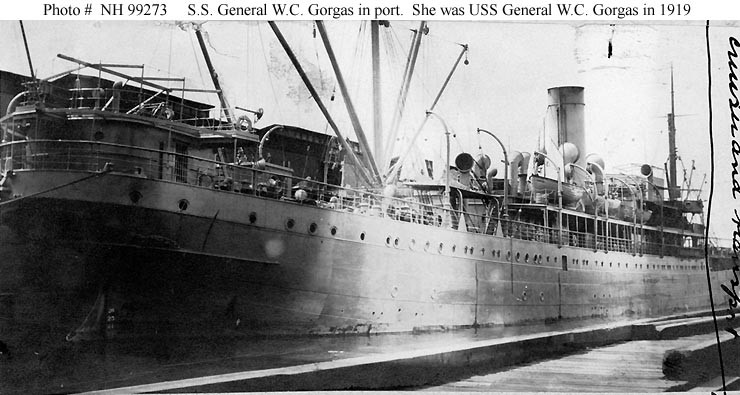

Originally the Prinz Sigismund, the steamer was seized from the Germans during World War I and became an American troop transport, renamed the General W.C. Gorgas. Later the ship was used for commercial purposes, including salmon cannery work, until World War II when she once again became a troop transport. In 1945 she was sold to the Soviet Union. 
Photo courtesy of Naval History and Heritage Command.

Many other tugs and boats were hired as extras. Employees of Foss Tugboat and Barge were pulled into service by Wedell Foss, a strong booster for the production. 

Mervyn LeRoy came to town to direct his floating actors. The director of Little Caesar was quoted in the paper as saying "I've directed mobs of 'gangsters,' but you can't talk to a tugboat -- you must do it with signals to their pilots." (Seattle Daily News, April 11, 1933.) Crowds gathered on the shores of Lake Union to watch the action.


The tug Sea King played the part of the Firefly in Tugboat Annie.
Photo courtesy of Puget Sound Maritime Historical Society.


Because many of the maritime scenes were filmed in Culver City, it was necessary to build a replica of the Wallowa for exterior shots. Well-known naval architect Carl Nordstrom was hired to prepare plans of the boat. The Seattle Daily Times reports that Nordstrom was to draw up plans for both the Wallowa and the Sea King, but it is possible that the plans for the Sea King were never used. Portions of the Glacier Queen were constructed on MGM's Stage 22. 


That a replica of the Wallowa was built is confirmed by photos in the book M-G-M: Hollywood's Greatest Backlot which show the tug on a studio lake as late as 1970 alongside other famous film vessels including the Cotton Blossom from Showboat

Plans of the Arthur Foss as drawn by naval architect Carl Nordstrom. The venerable tug still floats at the historic ships pier at Lake Union Park. Image courtesy of Northwest Seaport.
Movie magic allowed these boats to change identity for subsequent movies. The Wallowa replica may or may not have been used as an extra in another Wallace Beery film, Barnacle Bill, in 1940. About the same time the erstwhile Narcissus had a narrow escape. According to M-G-M: Hollywood's Greatest Backlot
"In November of 1940, because of falling high-tension wires, fire raged through the area, destroying much of the [Lot One] set and threatening the old Tugboat Annie tugboat. The heat was so intense, and aggravated by a stiff ocean breeze, that windows in the studio's Cartoon Department across Overland Avenue were shattered....The tugboat survived, however, and would finally be secured on the Lot Three lake." (p. 119)


The galley of the Arthur Foss is a bit more cramped that that of the Narcissus in the movie. 
Photo, Alan Humphrey.

Seattleites also had their chance to be extras in a real Hollywood movie: somewhere between "a few score" and ten-thousand locals turned out as unpaid extras for the big scene where the Glacier Queen steams alongside the Bell Street Pier to brass bands and streamers. Other locals were on hand as background characters in the scenes filmed on Lake Union. A local houseboat dweller, Maria Fisk, was hired to double Marie Dressler in long shots on the boat. Seattle Mayor John Dore, enthralled by movie-making, reportedly donned a sailor's cap to appear in some scenes. Of course local pilots and crewmen worked the boats. Captain Clarence Howden piloted the Wallowa/Narcissus.

ARC LIGHTS IN SEATTLE

Tugboat Annie had its world premier at the Fifth Avenue Theater in Seattle on July 28, 1933. The city made the most of the honor. The first showing, at 11:30 in the morning, was heralded with a cacophony of ships whistles in the harbor. The big event in the evening involved fireworks, balloons, klieg lights, and many local celebrities including Mayor Dore and Lieutenant-Governor Victor Meyers. Governor Clarence D. Martin sent a telegram, as did the film's stars. The Seattle Star covered the celebrations:
"While a cool evening breeze brought the salty breath of Elliott bay up thru downtown canyons, glaring arc lights swept the faces of thousands who came to watch the first showing of the picture which is to send the echo of Puget Sound towboat whistles around the world." (July 29, 1933)
The ferryboat Washington of Kirkland makes its way through the Ballard Locks in this photo courtesy of Kirkland Heritage Society. The museum ship St. Paul can be seen in the background with an "open" sign attached to its foremast. 


TUGS IN TACOMA

Tacoma held its own premier of the movie three weeks following the Seattle event, rightfully claiming a share of cinema history. "Secoma," after all, was a mash-up of the two port cities. On the Sunday following the opening the first Tugboat Annie races were held on Commencement Bay to great fanfare. Myth has Marie Dressler personally presenting the silver loving cup to Captain Arthur Hofstead of the tug Peter Foss which had nosed out the Captain O.G. Olsen by a scant three feet.

Although the Marie Dressler Loving Cup may have been donated by the actress or her people, the Tacoma News Tribune informs us that the prize was presented by Leroy V. Johnson, general manager of the Jensen-von Herberg Company which owned the local theater showing Tugboat Annie.

Tugboat racing became a staple at maritime events in Puget Sound from that day.


A Tugboat Annie race photographed by Joe Williamson, circa 1940.
The Arthur Foss is in the lead. Courtesy of Puget Sound Maritime.

THAT'S A WRAP

Marie Dressler died of cancer a year to the day from the Seattle premier of Tugboat Annie. Her character, Captain Annie Brennan, pursued her adventures on Puget Sound in two more movies, a short-lived TV series, and some 75 short stories which trickled out from the pen of Norman Reilly Raine until the author's death in 1971.

Seattle would not see another major motion picture company until Elvis Presley came to town in 1962 to film It Happened at the World's Fair (released in 1963). By that time Seattle was identified more with the aerospace industry than with the maritime. Tugboat Annie remains a pleasant reminder of rough and tumble days in a waterfront town.


Cast and crew publicity photo for Tugboat Annie, 1933. From left front are Wallace Beery, Marie Dressler, Mervyn LeRoy, and writer Norman Reilly Raine. Famed cameraman Gregg Toland leans over Miss Dressler. Image Courtesy of Tacoma Public Library, C157920-3.


Selected sources:  

  • Selected articles from The Seattle Daily Times, The Tacoma News Tribune, The Seattle Star
  • Stephen Bingen, Stephen X. Sylvester, and Michael Troyan, M-G-M: Hollywood's Greatest Backlot, 2011.
  • Norman Reilly Raine, Tugboat Annie (collected stories), 1934.
  • Norman Reilly Raine, "That's How Tugboat Annie was born," Pacific Motor Boat, November 1934.
  • Mervyn LeRoy with Dick Kleiner, Mervyn LeRoy: Take One, 1974.
  • Marie Dressler with Mildred Harrington, My Own Story, 1934.
  • Matthew Kennedy, Marie Dressler: A Biography, 1999.
  • Victoria Sturtevant, A Great Big Girl like Me: The Films of Marie Dressler, 2009.
  • Betty Lee, Marie Dressler: The Unlikeliest Star, 1997.
  • Michael Skalley, Foss: Ninety Years of Towboating, 1981.
  • "The Providence Steamboat Company: Still a Family Business," PowerShips, the Magazine of the Steamship Historical Society of America, Summer 2012.
  • Gordon Newell, ed., The H.W. McCurdy Marine History of the Pacific Northwest, 1966.


*In good Hollywood tradition, Dressler's age is uncertain. Dates for her birth range from 1865 to 1868 to 1871, the date that appears on her grave marker.

Sunday, September 6, 2015

Into the Surf: The Point Reyes Historic Lifeboat Station


From 1927 until 1968 the Coast Guard maintained a life-saving station at Point Reyes, California, in the shadow of Chimney Rock on Drakes Bay. The station house, with its marine railway, still stands, although it is used only occasionally by nonprofit groups. Recent visitors to the shoreline witnessed some restoration work going on and were allowed a glimpse inside the structure.


The road to the Lifesaving Station is a ten minute walk from the public parking lot at Chimney Rock. Look for signs pointing to the station (to the right as you face the sea) and to the Elephant Seals (to the left).


The tracks leading from the station directly into the surf by means of an incline plane are probably the last existing marine railway on the Pacific Coast. Motorized lifeboats were assured a fast launch into the surf in times when every minute counted.


The cradle that held the motor lifeboat  waits in the ground floor boat bay for the last lifeboat, currently undergoing restoration. Living quarters for crew were on the second floor.


The names and relics of wrecked ships adorn the walls of the ground floor boat bay: the cargo ship Munleon, lumber steamer Hartwood, the oil tanker Richfield were three of the lucky ones among many wrecks during the 1920s and 1930s. All lives were saved. During this period a shipwreck and rescue often drew crowds of spectators to the station grounds.


By the 1950s technological advances in lifesaving began to put the Point Reyes station, with its 36-foot lifeboats and breeches buoy, out of business. In 1968 the station was closed; in 1989 it was declared a National Historic Landmark. A modern Coast Guard rescue, complete with helicopters, now operates out of Bodega Bay. 


Accidental tourists were treated to the release of rehabilitated sea mammals: three juvenile California sea lions (Carmella, Mariachi, and Leeward, above) and one young female elephant seal (Rail Buddy below), restored to health by the Sausalito-based Marine Mammal Center. These guys heard the call of the sea and knew exactly what to do.


The U.S. Life-Saving Service (USLSS) was founded in 1871. In 1915 the service merged with the Revenue Cutter Service to form the modern Coast Guard.


The Point Reyes Lifeboat Station was originally established on another spot on the peninsula (the much less protected South Beach) in 1888. During this period, surfmen went out in man-powered boats. (Point Reyes National Seashore photo)

The life-saving station at Point Reyes has a connection to another landmark in the district....a tiny cemetery overlooking Drake's Estero on the road between the coast and town. For photos of the gravestones of some surfmen see the author's own blog, Remnants of the Past.

Thanks to park ranger Sarah at the Lifeboat Station for information and to Alan Humphrey for photography.

-- Eleanor Boba

Sunday, August 2, 2015

Picnic Point Mystery Revisited


Several months ago we posted Joe Baar’s query about a mystery hull at Picnic Point. Since that time Joe has pulled together information from a number of sources to provide this likely solution to the mystery.

A lot of information has come in recently about the hulk beached north of Picnic Point. This vessel’s final name was MV PACIFIC QUEEN, official number 257731. Eight ships of this kind were built as “Auxiliary Rescue and Salvage” vessels (ARS) during 1942 and 1943. Three of these wooden vessels were originally authorized for construction under Lend-Lease contracts with Great Britain as “British Auxiliary Rescue and Salvage” ships (BARS) to help stem the rate of merchant ship losses due to U-Boat attacks in the North Atlantic. Other methods for preventing such losses proved successful more rapidly than the rescue and salvage vessels could be put into service, so all these lend-lease agreements were cancelled before any of the ships were completed. Anticipating a need in the Pacific Theatre, the U.S. Navy continued construction begun under lend-lease and obtained authorization for five more vessels of a similar design.


NOAA Chart showing location of the hulk.
Using tabular information collected from Silverstone’s US Warships of World War II, the U.S. Bureau of Customs’ Merchant Vessels of the United States, and NavSource.org on the internet, I was able to organize data about the eight ARS vessels to give what I believe is a definitive answer about the true origin of the hulk on Franzen Beach. My findings are summarized here.

Two ships were lost in 1945 due to accidents. Of the remaining six ships, three are positively identified in multiple published sources as having been sold into mercantile service after 1946. A fourth ship was transferred to the government of Denmark in 1947. Of the remaining two ships, only one was constructed with twin screws (two propellers). That ship was USS WEIGHT, ARS-35, ex-PLYMOUTH SALVOR, BARS-7. This exercise specifically rules out USS ANCHOR, ARS-13, as the original identity of MV PACIFIC QUEEN.

Pacific Queen after her rebuild by Puget Sound Boat Building Corporation in 1949.
 Courtesy Tacoma Public Library.

A number of rumors about this vessel have circulated since 1949, and need to be put to rest. First, the Tacoma News Tribune reported on 5/15/49 that the newly rebuilt ship was “formerly an Army tug,” which is only partly true in the generic sense that a salvage vessel can be used as a tug; and there is no record that any of these eight vessels ever operated under the auspices of the U.S. Army. Second, at least two otherwise reliable sources – Merchant Vessels of the United States and the Marine Digest contain information that this ship was built in Stockton, California, by Colberg Boat Works, but every source agrees that all three of Colberg’s ARS vessels were built to the single-screw design, and this hull definitely incorporates struts for twin screws. Finally, this vessel was never a minesweeper even though it has a wooden hull, whose heavy construction shows its suitability for a much different mission: ocean salvage.

The U.S. Treasury Department assigns official numbers only to yachts and merchant vessels, not to U.S. naval vessels, but documentation required to register the vessel and obtain an official number as a merchant vessel in 1947, ’48 or ’49 should link that number to the builder’s “Master Carpenter’s Certificate”, which will provide absolute proof of this hulk’s identity. Both Merchant Vessels of the United States and a photo of the vessel’s official number and net tonnage carved into her main beam, kindly sent to me by Karl Elder, have identified the hulk high on Franzen Beach as MV PACIFIC QUEEN. In addition, one of Karl’s relatives has recently measured the hulk at 173’-0’, which matches the length given in Merchant Vessels.

Photo, Everett Daily Herald. Date unknown.
Thanks to Karl Elder for supplying us with this image.
          

Whichever ARS finally became MV PACIFIC QUEEN, Kyle Stubbs and Karl Elder have both provided a wealth of information about the mercantile history of this ship. Karl is the grandson of Arvid Franzen, the final owner of PACIFIC QUEEN. Kyle has fleshed out some of the tabular information I’ve put together above. He reports the vessel was sold to Puget Sound Boat Building of Tacoma and they rebuilt her in 1947-49 as a refrigerated cargo ship. By 1950 Merchant Vessels shows ownership as Pacific Queen Fisheries of Tacoma, and one of the salvors, Dave Updike, informed the Marine Digest via Doug Egan that MV PACIFIC QUEEN remained in the Bristol Bay fishery as a fish packer and processor under this ownership. Thanks to Karl Elder for passing me his extract about this from the Marine Digest dated 2/14/1976.

On 9/17/1957 MV PACIFIC QUEEN sank at Tacoma’s Old Town Dock in about 30 feet of water as the result of a gasoline explosion and fire originating under the afterdeck. According to the Marine Digest, one crew member was killed in the conflagration. During 1958 the wreck was raised by Dave Updike and Jim Vallentyne, floated and towed to Lake Union in Seattle for removal of heavy internal items and the steel superstructure down to the main deck.


Photo,Todd Stahlecker, 8/1/2012.

Information about the sinking appears in Susan Hodges’ Cases and Materials on Marine Insurance Law (Cavendish, London: 1999). Two cases and appeals came before the United States Ninth District Court and all the issues raised were not fully litigated until late 1962. In Pacific Queen Fisheries v. Symes and in Pacific Queen Fisheries v. Atlas Assurance Company, the cases are summarized as follows:

PACIFIC QUEEN was a large refrigerated wooden hulled vessel which was engaged in freezing and transporting salmon catches from Alaska to ports in Puget Sound, Washington State. Unknown to the insurers, because PACIFIC QUEEN supplied fuel to the small fishing vessels operating with her, her [gasoline] carrying capacity had been enlarged from 3,000 gallons to 8,000 gallons. During the currency of the policy underwritten by the defendants, PACIFIC QUEEN suffered a violent explosion caused by the ignition of [this gasoline] and became a constructive total loss. The insurers refused to indemnify the owners for the loss. They contended [among other things] that (a) she was unseaworthy, and (b) she had been sailing in contravention of the Tanker Act.

The United States Court of Appeal [sic] upheld the District Court and ruled that PACIFIC QUEEN had been sent to sea unseaworthy with the privity of her owners; furthermore, as the owners had not exercised due diligence, the loss was not covered by the Inchmaree Clause. However, the Court specifically refrained from ruling the adventure illegal, as [this] was not the controlling issue of the case. It was not the Court’s wish to set a precedent until all the ramifications of the issue had been considered.

At the Coast Guard’s and Seattle Fire Department’s requests the salvors towed MV PACIFIC QUEEN’s light hulk from Lake Union and beached it north of Picnic Point at the burning grounds of Franzen Beach. Karl Elder reports he was 11 years old at the time and watched the tug labor to ground the wreck securely for hours before and after the high tide. This activity left a large prop-wash depression in the beach, which Karl says took several years to fill in. His story continues, “My grampa blew the hole in the port side to anchor the Queen. He paid Updike or Vallentyne $1 to get a receipt.” And finally, “My grampa told me he didn't burn it because they pushed it in too close to the hillside and he didn't want to set the woods on fire.” This is a beautifully clear and concise explanation why the hulk is still visible for us to ponder.

I am deeply grateful to Karl and Kyle for participating in this discussion.    
                       
-- Joe Baar     


Photos of the derelict vessel accompany a KOMONews.com webposting and my be viewed here. Note, that some details in the article, including the date of beaching, are incorrect.

Friday, June 26, 2015

What’s the Scuttlebutt?*


There’s a lot happening at Puget Sound Maritime this warm summer of 2015. Listen closely and you’ll hear what’s going on behind the scenes.

But first …
Imagine you are the captain of a Puget Sound ferryboat at the end of the 19th century, part of the famous “Mosquito Fleet.” Your job is to ferry passengers from Tacoma to Seattle, but Oh, No! There’s a log floating right in your path! A storm comes up suddenly! A passenger falls overboard! What’s a skipper to do?

Several new exhibits are in the works for the McCurdy Family Maritime Gallery at MOHAI that will help visitors understand the realities of navigation in the days when water was the primary highway for travelers around Puget Sound.
Our biggest project will be the installation of a large gaming console, referred to as a “touch table,” which will use historic photos and real events combined with modern animation to allow players to navigate Mosquito Fleet steamships around a variety of hazards along their routes.  Tentatively titled “Charting Our Course,” players will choose a course: for example, the Seattle to Tacoma run with the FLYER or the Mercer Island route with the FORTUNA. They will then follow the historically accurate route, making split-second decisions necessary to reach their destination safely in the face of real-life perils. The touch table will have an engaging soundtrack that will enhance the nautical feel of the Maritime Gallery and content that will attract kids and adults alike with its rich but fun presentation.

In addition to the permanent touch table, we plan to add a non-digital interactive mapping station where visitors will learn about and see historical mapping instruments, then use such tools to plot a course around Lake Union. Participants will be able to relate their maps to the panorama of Lake Union right outside the gallery windows.
For those who’d just like to get their hands on a ship’s wheel and steer, we will have a new hands-on helm station complete with ship’s wheel and engine order telegraph. Highlighting the building’s history as the old Naval Reserve Armory and the Maritime Gallery’s original function as a bridge deck mock-up, the helm station should be in place this fall!

The Mosquito Fleet touch table and the mapping station are currently in the planning and design stages. It takes a certain amount of resources to bring exhibits into the 21st Century and these are no exception. The combined cost of the two exhibits will reach over $150,000, of which a large portion is being generously donated by the McCurdy Family. The rest must be made up of grants and individual donations. Details on a campaign to raise funds for these projects will be coming your way soon!
………………………………………………………………………..

FROM THE ARCHIVES

A year ago PSM took possession of a large cache of ships plans drawn by the late, renowned naval architect Edwin Monk Sr., along with a collection of photographs and artifacts. These plans, photos, and objects, while well organized, require proper archival storage and cataloging. It will be a big job! UW Information School interns Jodi Myers and Suzanne LeDoux have laid the groundwork for us by formally assessing the collection and estimating the resources (time, money, personnel) required to complete conservation. They have also drafted a user guide for staff and volunteers working on the conservation project. This work will be a big help to us as we plan our collections work and seek grants to fund it.

………………………………………………………………………………………………………………………………………………….

Special thanks to the McCurdy Family for initial funding of our exhibits enhancement project; Christina Januszewski, UW Museology intern, for researching and designing the mapping station; MOHAI for donating the touch table console; the Harbor Club of Seattle for donating the ship’s wheel; James McCurdy Sr. for donating the engine room telegraph; Jodi Myers and Suzanne LeDoux, UW iSchool interns, for assessing the archival and cataloging needs of the Edwin Monk Sr. Ships Plans Collection; and students of the UW Museology Program for evaluating our gallery visitor experience and pointing us toward the future.

* Scuttlebutt: a cask of water with a hole allowing sailors to get a drink; a place to exchange news and gossip; news and gossip!

Thursday, May 21, 2015

Deep Focus, Part II: Joe Williamson, Reluctant Photographer

In our very first blog post we talked about the Joe Williamson Collection of maritime photographs which forms the heart of our archives. In researching the story we learned some interesting tidbits about the man who was an avid collector of photographs, a photographer in his own right, and a sailor, as well as one of the founders, and first president, of our historical society.

First and foremost Joe Williamson (1909-1994) was a man who loved ships. Almost every article and interview about him refers to the fact that he wasn't wild about photography itself. It was the output of his work that held his fascination. He loved developing film.

In 1979 intrepid newspaperwoman Lucile McDonald interviewed Joe for an article, reproduced here, that appeared in the December issue of the The Sea Chest, the quarterly journal of the historical society. Read it to hear, in Joe's own words, how he amassed his collection of maritime photographs, as well as stories of his early seafaring adventures.


This photo shows Joe, as a lad of six or so, on a bike along with his brothers Glen (left) and Paul, circa 1915. Photo courtesy of Leslie Williamson Lowell. As a young man Joe could be spotted riding his Indian Scout motorcycle on his rounds making deliveries for Bartell Drugs and other concerns.  

Ships and shops

By his late twenties, Joe had settled down somewhat and was selling maritime photographs from a waterfront shop he called the “Marine Salon.” Between 1937 and 1962 Joe operated a series of small shops, all on or near the Seattle waterfront.

PSMHS Research Coordinator Karl House recalls patronizing Joe’s shops as a youth:

I first met Joe Williamson because I used to buy pictures of tugboats from him when I was a young boy in elementary school, maybe eight or nine years old. I knew where it was, ‘cause you could go there on the bus. Well, I knew the shop because I’d been in with my dad before, and I knew it cost 50 cents to buy an 8 by 10 picture of a tug. Their photo salon was on the little viaduct that goes from First Avenue over the railroad tracks into the Colman Ferry Dock. That was the first Joe Williamson shop I was in. Subsequent to that he moved to a larger shop in the ferry dock itself and I bought a number of pictures over the years there. He was in the shop on the ferry dock for several years.

He was courteous and he would pull out pictures of various tugs, even though I only had enough money usually to buy one at a time. I’d pick out a picture and he’d sell it to me. If he wasn’t there, his wife would wait on me. She knew about everything that was in there, where the things were filed and so forth. Everybody on the waterfront pretty much knew a lot about what Joe did.

Ron Burke, long-time editor of the PSMHS journal The Sea Chest, also has fond memories of visiting Joe’s shop.

I grew up in Bremerton and whenever I came to Seattle [on the ferry], I would walk past Joe Williamson's Marine Photo Shop on the Marion Street pedestrian viaduct from the ferry dock. As a teenager and a Sea Scout in the 1940s, I got interested in maritime history and I used to drop by his shop and talk to him about it.  
One Christmas my grandmother gave me five dollars.  I took it to Joe's shop and started to order photos and told him to stop me when I reached the five dollar limit.  As I recall, I was able to buy eight photos, all of which I still have and [some of which I]  have used in The Sea Chest. 
Later, during my college summers, I worked on eight different ferries and ships and bought photos of each of them from Joe.  Also, in that work, I needed Coast Guard endorsements which required current photo ID cards and I always went to Joe to take my photos.

Indeed, Joe’s work extended beyond simply taking pictures and selling them. He was a creative entrepreneur, turning ships photos into Christmas cards, selling photos to various newspapers and periodicals, and collaborating with marine historian Jim Gibbs on a series of pictorial books.

During the same period he owned two ships, which he christened PhotoShip and PhotoQueen, respectively, and which he captained in his quest for adventure and photos. Karl House remembers them:

He had two different boats from which he took pictures. The first one was called PhotoShip and I’d say it was maybe a 30-foot boat. Then he bought a larger boat, called PhotoQueen, which was probably 50 or 55 feet. He could stay out on that boat for longer periods of time because it had all the cooking and live-aboard facilities that you needed on a boat that size. So he’d go as far out as the San Juan Islands and do some photo shoots there. Anyplace there was a photo opportunity.


Joe’s shop was always more than a collection of prints; it grew into a sort of gallery of maritime artifacts, including ships models, ships name plates, and other “relics and souvenirs” as the daily paper described it. One particular relic surfaced among Joe’s trove in 1947: part of the whistle from the well-beloved Bailey Gatzert, a sternwheeler which plied the waters of Puget Sound from 1890 to 1926. The familiar Bailey Gatzert whistle consisted of four chimes (some say five), one of which Joe holds above. Seattle Times Archives, December 7, 1947.  

Joe at MOHAI

Museum of History and Industry Curator of Photography Howard Giske met Joe shortly after his collection was acquired by PSMHS and conveyed to storage at the old MOHAI at Montlake. In his early 70s at that point, Joe traveled from his home on Bainbridge Island to lend a hand in the darkroom:


He lived in Winslow, not far from the ferry dock. He would walk down to the ferry dock, get on the boat, gab with old pals and cronies, I’m sure – he knew a lot of the ferryboat people. He would walk off at Colman Dock and would walk from there to MOHAI…to Montlake! He always had interesting stories, charming tales to tell about his walk to the museum that day. Just a chatty, lively fellow to have on the team.

PSMHS board member Pat Hartle remembers that Joe would also walk from the ferry dock to the Yankee Diner in Ballard for dinner meetings of the historical society. Each jaunt was a walk of about five miles in one direction!

Former Puget Maritime Board President Jim Cole, who led the charge to obtain the Williamson Collection, recalls Joe at MOHAI:


Of course, the collection was his child. He wanted to make sure everything was done right. It was probably hard to let go.

The Man with the Pipe

Joe is most often remembered as the man with a pipe in his mouth. Howard Giske recalls setting up some of Joe’s old darkroom equipment at MOHAI: 

He had always been a pipe smoker [so] we really had to work hard to get those lenses and condensers and things all cleaned up. He loved the darkroom work, he said. He really wasn’t all that interested in the photography and the camera work, but he’d smoke his pipe back there [in the darkroom.] A cloud of smoke! You couldn't catch anything on fire really, but he would kind of pollute the air with that old pipe. In a lot of the pictures taken of him you see him with his pipe.


Joe (center) with the other founding members of the Puget Sound Maritime Historical Society in 1948. From left: Jim Gibbs, Tom Sandry, Joe, Bob Leithead, and Austen Hemion. Photo, PSMHS.


-- Eleanor Boba


Sources:  

  • The corporate records of the Puget Sound Maritime Historical Society.
  • McDonald, Lucile. “The Famous Williamson Photo Collection.” The Sea Chest December 1979.
  • Hemion, Austen. “Joe D. Williamson.” The Sea Chest June 1994.
  • The Seattle Times Historic Archive, various articles.
  • Oral history interviews with Jim Cole (2015), Karl House (2015), and Howard Giske (2015.)
  • Email communication with Ron Burke (2015) and Pat Hartle (2015).
  • Special thanks to Joe’s great niece, Leslie Williamson Lowell, for use of a family photo.

Wednesday, April 15, 2015

Digging Deep: A Photo Research Case Study

Puget Sound Maritime volunteer researcher Joe Baar was given the assignment of identifying a number of stray photos unearthed during preparations for our recent big move. His analysis of this photo demonstrates the difficulties and rewards of engaging in photo forensics.

Photo courtesy of Puget Sound Maritime Historical Society, for now....

The Photo

Our photo is a black and white matte print, approximately 14 x 10 inches, of a Japanese motorship maneuvering in a waterway on the U.S. Atlantic coast, just offshore from lighted buoy #30, with a Moran ship-assist tug alongside. PSMHS records give no evidence of the print’s provenance.

The Ship

Neither the ship’s name nor that of the tug is fully legible on the print. However, the shipping company is clearly identified by the ship’s funnel insignia and by lettering on its hull: “Mitsubishi Line”. The ship’s hull, superstructure and masting shapes place it at a time after World War II; the tug’s streamlined funnel shape contributes to this placement. A rough estimate of a ship’s size depends largely on the relative size of its visible components, their proportions, and how they compare to other, known, vessels. If a normal deck is about 10 feet high, then what multiple of this distance matches the height of the ship’s bow as it appears in our photo? Since the ship is positioned at an angle to the camera and its bow is farther away than its other parts, how much should we correct this height for perspective? All this information taken together yields an estimate of around 450 feet in length and probably smaller than 10,000 gross tons measurement – a slightly less boxy design than our World War II EC-2 Liberty ships, but similar in size.

Lloyd’s Register List of Shipowners for 1959-60 shows vessels belonging to Mitsubishi Kaiun Kaisha to include six 7,500 GRT motor ships built 1951-56 and three 8,400 GRT motor ships built 1957-58. Photographs of all nine of these ships, available on the internet, show the former class was configured with a “three-island”-type hull and the latter class was flush-decked with a forecastle. Inspection of the vessel in our photo shows it to be one of the three later vessels, either CALEDONIA MARU, GLORIA MARU, or OCEANIA MARU. Very close inspection of the name visible on the starboard bow allows a conclusive identification as GLORIA MARU.

The When

Japanese shipping lines underwent a consolidation in April 1964 (Chida and Davies, The Japanese Shipping and Shipbuilding Industries, Bloomsbury, 1990). In that month Mitsubishi K.K. transferred its vessels to Nippon Yusen Kabushiki Kaisha (NYK Ltd.), whose funnel, hull colors and markings are entirely different from those of Mitsubishi, so our photo was taken between March 1958 when GLORIA MARU went into service, and April 1964. Lloyd’s Register also reflects this changeover.

A postcard sold in October 2014 on eBay shows GLORIA MARU in a view almost identical to the one in our photo. In general, the ship appears to be moving ahead slowly; a Moran tug is alongside the bridge superstructure moving ahead almost at full speed on what appears to be a parallel course. The card’s reverse side contains the following information:

NEW YORK HARBOR
The M.V. Gloria Maru, with a Moran docking tug at the bow, on its maiden arrival in the world’s busiest harbor. Photo from Moran.

This photo appears to have been taken less than five minutes later than the one in our print, adding significantly to our understanding of the scene. Lacking evidence to the contrary, for the time being we can accept this, and our own photo, as views of the ship on its first arrival in New York. 


EBay Postcard view of M.S. GLORIA MARU taken a few minutes later than our view.

The New York Times’ “Shipping -- Mails” news discloses 14 voyages GLORIA MARU made to the United States’ Atlantic Coast between March 1960 and June 1964. The first arrival occurred on 3/27/1960 from Japan via Cristobal, Panama, and that voyage departed New York on 4/9/1960 destined for Kobe, Japan. A similar pattern was in place for all the following voyages, with occasional intermediate stops, either inbound or outbound, in Hampton Roads, Philadelphia and Baltimore. GLORIA MARU’s Atlantic Coast service continued after June 1964 but since she came under NYK ownership and colors the previous April, information about these voyages is not germane to the identification of this photograph.

The Where

A foreground feature in our photo is lighted buoy number 30. The Moran ship-assist tug would seem to place the general location west of Sandy Hook and south of Orient Point, Long Island. The U.S. Coast Guard’s current Light List for the northern portion of the Atlantic coast discloses 29 red “30” buoys, of which four are lit. One of these is out-of-area in Maine and two have bells, one at Gowanus Flats in New York Harbor’s Upper Bay and one in Raritan Bay just south of Staten Island. The remaining R “30” buoy is in Arthur Kill between Fresh Kills Reach and Tremley Point Reach. The 1947 chart edition does not show any buoy at this location, and the 1966 edition shows this buoy just south of a relatively new pier and dredged dock at the channel’s bend between these two reaches. The surrounding land on both sides of Arthur Kill at this location is low and marshy, which corresponds to what our photo shows. Two chimneys north of Tremley Point, as noted on Chart 285 of the U.S. Coast and Geodetic Survey, are just visible in the distance on our print, ahead of the tug’s pilot house.


U.S. Coast and Geodetic Survey Chart 285, 1966, for the area covered by both photos, showing buoy R30.

The current Google satellite view shows the pier’s southwestern end collapsed into Fresh Kills Reach and the middle part of the pier is enclosed in what appears to be a steel-clad structure two or three storeys high, extending over the dock and supported on three large cylindrical caissons in Arthur Kill. The building extends inland some distance to at least 15 truck loading docks and the site includes baled material stacked on an associated hardstand and two loaded, uncovered barges moored at the remaining northeast pier. Google identifies this complex as the Pratt Industries Paper Division, whose own web site lists its activities as a paper mill for recycled corrugated cardboard. The whole complex is located just south of the Travis-Chelsea NRG Energy electricity generating plant, whose structures were first placed at this location in 1948 by Staten Island Edison. A road and conveyor system connect Pratt and NRG, making possible use of Pratt’s waste products as fuel for the power plant. Further research is needed to determine what the predecessors of the recycling facility were, in order to understand what cargo GLORIA MARU brought or took away in 1960.

In our photo GLORIA MARU appears to have just finished backing down and her engine has completed shifting to an ahead bell. Evidence for this activity is the flattening boil of propwash along her starboard quarter with a growing wash into the stream astern; and a dispersing cloud of smoke wafting toward the photographer. These ships were propelled by a single direct-drive 16-cylinder diesel engine, normally producing visible exhaust when revolutions are increased under maneuvering conditions. GLORIA MARU has backed out of her berth at Travis-Chelsea and is headed north toward Kill van Kull and New York Harbor. If the date is before April 8th then she’s bound for Norfolk; if it’s April 9, 1960 then she’s headed to Kobe, Japan via Panama.

The Why

The print in our collection lacked any material to substantiate its origin, either as notations on the print’s face or on its reverse side, or as an attachment. A search within the contents of all our Deeds of Gift might turn up a reference specific to this print, but such a search would consume far more resources than we have available. We are thus unable to determine where this photo should reside in one of our collections, but whether it should reside there is now easily answered: since our identification process has now placed the photo’s venue definitively on the Atlantic Coast, it clearly falls outside our area of interest and is most likely a candidate for de-accession from our collection.
****


Joe Baar has been fascinated with ships since his childhood on Brace Point. His lifelong avocation has included stints with the Sea Explorers, small-boat school courtesy of the U.S. Army, working on yachts on Lake Union, and amassing a large collection of maritime books.

Wednesday, March 25, 2015

Navigating the Archives with Karl House

Anyone who has called on the resources of the Puget Sound Maritime archives in the past decade has likely made contact with Karl House, the Society’s Research Coordinator. If he can’t find it, it probably can’t be found.

Karl’s long career navigating on sea and land may have helped prepare him for this position. In a series of oral history interviews, Karl shared his personal history with us, a history that begins close to the water.

Before he was four, Karl spent time on board the tugboat Defiance, captained by his father for Washington Tug and Barge Company.

He was towing sawdust barges between the mill at Port Gamble and the paper mill at Port Townsend. I was able to ride with him on some of those trips. They’re really etched in my memory and I’ve been fond of tugboats ever since.
Junior Mariner Karl House on board the tug Defiance, c. 1938. 
Photo courtesy of Karl House.

Like falling off a log

Tugboats became a recurring theme in Karl’s life. The day after he graduated from Queen Anne High School in Seattle, Karl signed on as deckhand aboard a Foss Company tugboat, the Hazel Foss. He continued to work for Foss and other companies during summers and breaks from college, earning enough to pay his way through the “U Dub.” He remembers the work being lots of fun, with the possible exception of one memorable event in 1952:

I fell off a log raft being towed by Foss #18 on the Duwamish River in December of 1952. It was dark out. I had moored a log raft at the South Island log storage on the Duwamish River. I had tied it up and I was returning to the tug to take the tug’s towing bridles off the front end of the log raft and when I went to remove the second bridle the boomstick [one of the long logs that corralled each section of logs] turned slightly and I fell overboard.
I was dressed in winter clothing: heavy jacket and shirt and I had on these heavy boots that were used for working on log rafts. When I fell overboard, because of the current going downstream in the river, I was washed under the logs in the first section of the tow. The logs were tight enough together that there wasn’t room for me to climb up on a log, so I had to stay underwater for about 70 feet until I came to the next section of logs where there was a crosswise boomstick and I knew there would be an opening of eight or ten feet [before the logs in the next section,] so I felt the bottom of the boomstick and I was able to grab the bottom of the boomstick and pull myself over the side and get up out of the water.

In the Navy

The year 1955 was an eventful one for Karl. In short order he graduated from the UW with a degree in transportation business, married his high school friend Deane Hullin, and was accepted to the Navy Officer Candidate Program in Rhode Island. By the end of the year he was commissioned an ensign in the U.S. Naval Reserve. Shortly thereafter Ensign House shipped out on the General J.C. Breckinridge, a Navy troop transport and passenger carrier home-ported in San Francisco, giving him his first true deepwater experience.
We’d make a trip from San Francisco to Yokohama, maybe down to Okinawa, then turn around and come back, get into San Francisco and spend maybe four or five days there, fix stuff that was broken, re-store the ship and head back out again. So the ships were underway a lot!

Karl, right, and LTJG Hal Murphy in the pilothouse of the Breckinridge, 1957. 
For some reason Karl acquired the nicknames "Brow" and "Charlie Brow" while in the Navy!
 Photo courtesy of Karl House.


In 1957 Karl was transferred to the General William Mitchell, home-ported at Pier 91 in Seattle. On the Mitchell as operations officer and navigation officer, Karl found himself often negotiating the approaches to Incheon [aka Inchon], Korea, a place made famous by General MacArthur’s surprise invasion of the peninsula during the Korean War. He describes the challenges:

Incheon is on the west coast of Korea and it is about 40 or 50 miles inland through a bunch of small islands and rocks from the Yellow Sea. The tidal range of Incheon is about 28 feet, similar to the tidal range of Anchorage, Alaska. Because of the tidal range at Incheon there are a lot of tidal currents and, at that time, 1956-1958, there were no current tables published for Incheon so it was quite a learning process to try to figure out the currents and their velocities while entering and leaving the approaches to Incheon.
We never ran aground or wrecked, but the best information we had for charts were British hydrographic surveys from 1938. Because up until the time General MacArthur ordered the invasion at Incheon it wasn’t much of a port really. There are no pier facilities there so anything that comes aboard ship or goes off ship has to go by lighter, and it is mostly done at at least half tide or higher.

Why would MacArthur pick that spot then?

Because nobody thought that he would do that due to the navigational difficulties, shallow water at low tide, and so on. Incheon is on a latitude right across from Seoul, Korea and the Korean peninsula isn’t all that wide. So the reasoning for going in at Incheon was to cut off the North Korean forces which had penetrated south on the peninsula almost to the end of Korea before they were stopped. So MacArthur ordered the Incheon invasion to cut off the North Korean army from their source of supply -- food and ammunition and whatever else an army needs.  
Cover of a booklet detailing life aboard the General Mitchell
Courtesy of Karl House.

Back on Dry Land

With the conclusion of his required active duty, and with a wife and two young sons at home, now-Lieutenant House began his land-based career, while remaining a naval reservist. Going to work for his father-in-law’s company, the venerable Hullin Transfer Company, and its sister concern, Federal Transfer Company, Karl learned the business of trucking freight, working his way up from unloading box cars at night to general manager of both companies. His career at Hullin/Federal spanned 29 years until the business ceased operation in 1988. All the while he continued to drill with the Naval Reserve, both at Lake Union and at Sand Point.

Working for Hullin gave the Houses a chance to use a company-owned boat, the Davy Bill, for family trips to the San Juans and the Gulf Islands. Once again Karl was back on inland waters! After retirement Karl and his wife purchased a 42-foot fiberglass Grand Banks boat named Rapture which took them as far as Alaska. A favorite place for cruising family vacations was Desolation Sound in British Columbia.

At the age of 65 Karl took on yet another maritime career: tour boat captain. With a master mariner’s license obtained in 1999, Karl was able to hire out as a relief captain on several of the sightseeing boats that churned the waters of Puget Sound and Lake Washington, including the Spirit of ’76. Although generally enjoyable, the work did have its hazards:

More often than any other activities done with the Spirit of ’76 was hauling parties of University students which from time to time got pretty unsettling. It was licensed to haul as many as 298 passengers. I recall one trip that we had almost capacity. We had the University of Washington marching band and they invited their friends from the UCLA band that was in town. There was very little room on that boat with all those people on it.

Navigating New Waters

In 1981 Karl’s mother gave him a gift membership to Puget Sound Maritime Historical Society. Some years later he answered the call of then-PSMHS librarian Jack Carver to help out in the library.

The first thing I had to learn was where the stuff was in the library and what the extent of some of the  collections were to help find answers to questions coming in. Then one of the things I did was process photo orders when the person in charge of photographs was not present to do so, so I became somewhat familiar with handling the photos and I got a lot of help from the MOHAI [Museum of History and Industry] people: Howard Giske and Kathleen Knies and Carolyn Marr. They were all very good at teaching me how to do these things and continue to be very helpful and excellent people to work with.

In the decade plus that Karl has been working in the library (both at the old MOHAI and the new), he has become the go-to guy for research inquiries on all things maritime. MOHAI Curator of Photography Howard Giske sums it up:

To all of his colleagues at the MOHAI Resource Center library, Karl House is a reliable, diligent and deeply knowledgeable partner, the right man with the right answers to pretty much all maritime questions. If he can’t locate it in PSMHS’s extensive collections, he may be able to find it at home! And Karl’s friendly, easy-going personality is always welcome aboard the good ship MOHAI.

PSMHS boardmember Roger Ottenbach concurs, adding

He does all this in a way that the person asking the question feels he really enjoys providing the info.

No doubt they are right!

A full transcript of the oral history interview with Karl House is available in the PSMHS office: admin@pugetmaritime.org. For information on the PSMHS research holdings and how to access them, see our webpage: pugetmaritime.org/research.htm.


-- Eleanor Boba

Karl and Deane House, 2008. Karl in his service dress whites. 
The Houses have two sons, Drew and Todd. 
Photo courtesy of Karl House.